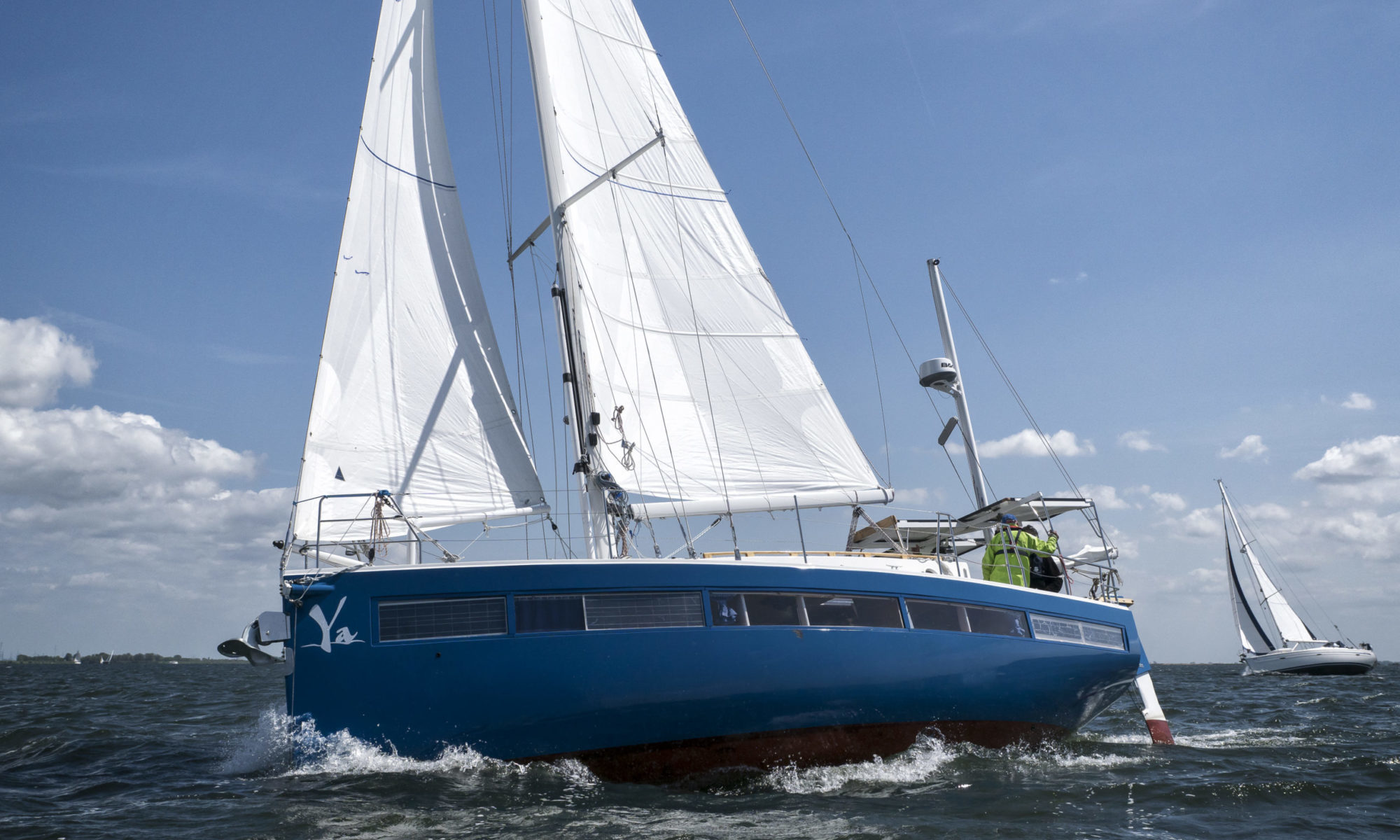
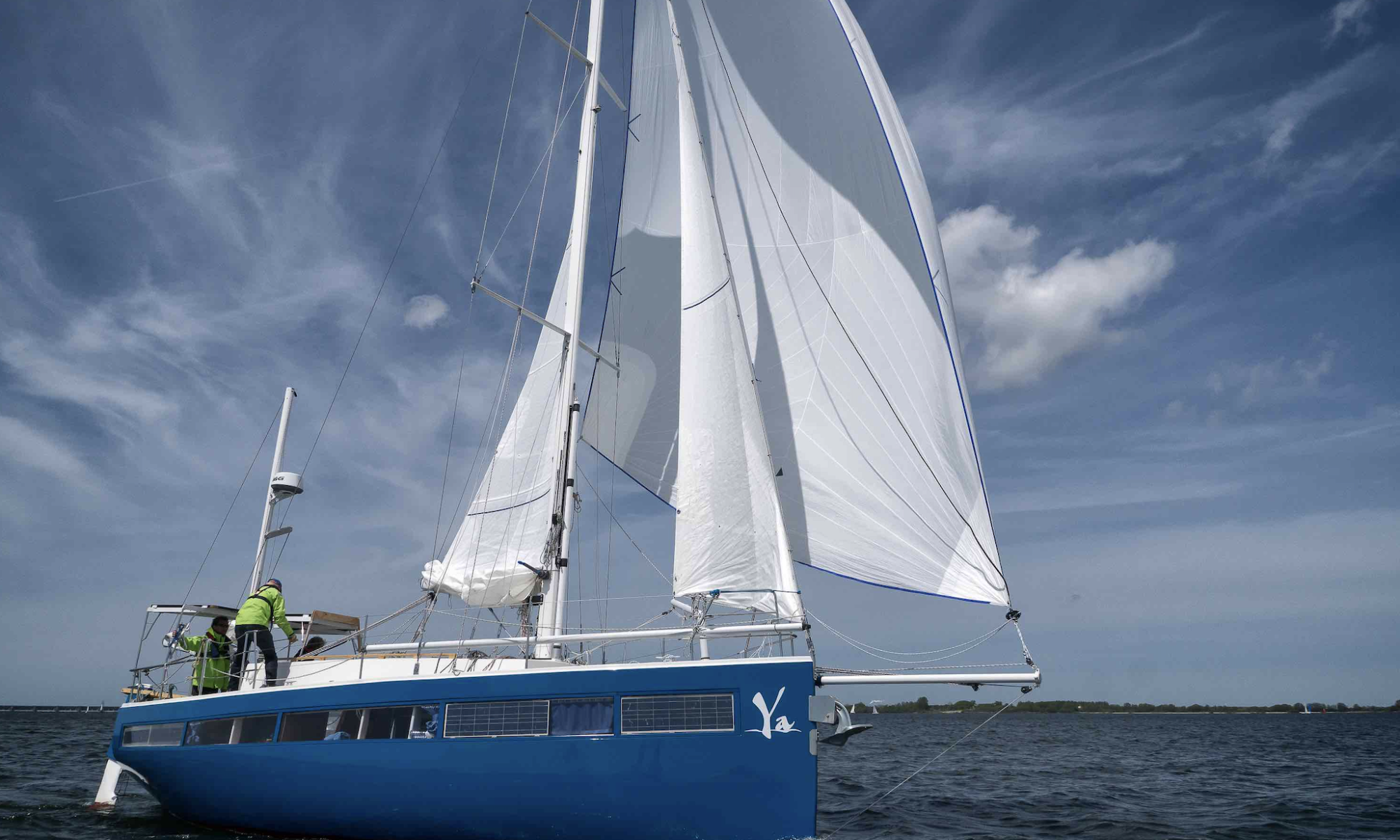
It is time for a new chapter in life. Peter’s body and soul ask to begin to say farewell to the ocean sailing.
After 11 years of intensive sailing, first as a charter yacht with guests on board and then for private purposes, the Ya is for sale.
You can find the sales story on the site of WhiteWhale Yachtbrokers .
Right now, we are slowly sailing to Europe, to finish her second circumnavigation.
Here you read what Peter has in mind with the Ya before, while and after all these years of sailing. You get some background reasons why he and Dick Koopmans sometimes chose for other options than what you see on the mainstream yachts. Like: why no traveler, no genoa rail, why a centerboard, why carbon masts and not aluminium? Yes, these choices often cost extra money, but at the end it was not that much; the price is probably 10% higher, but you win a lot on safety, on comfort, a better trim. Often it also implies that you are safer and more prepared to get into adventures off the beaten track.
Design of the Ya
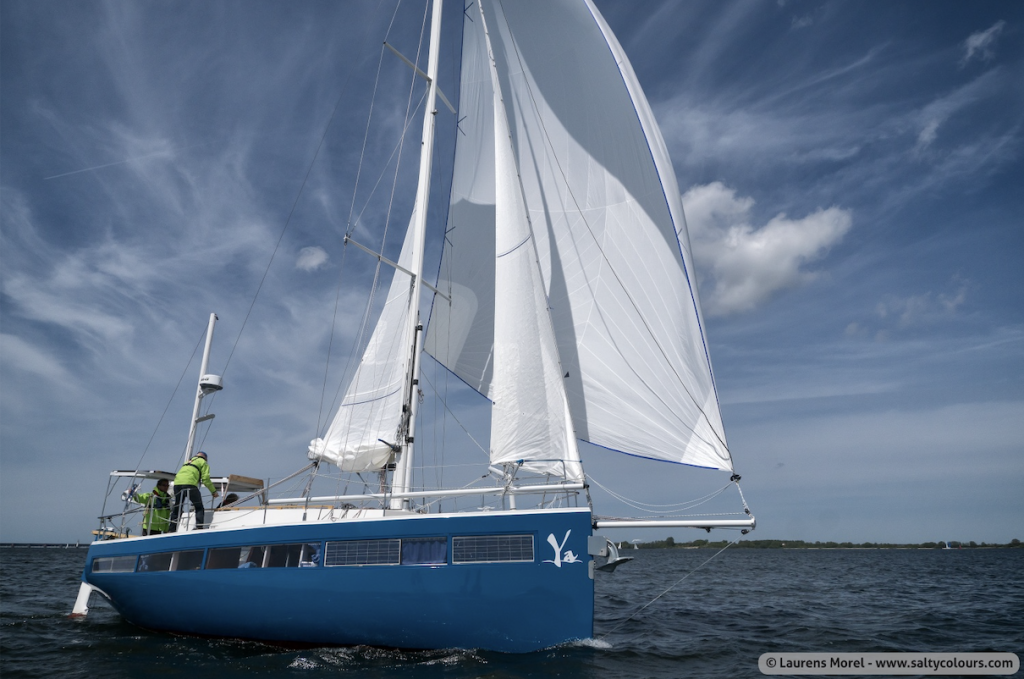
In 2010 three naval architects were challenged with a tender to design a small but comfortable, spacious yacht that would sail and cruise the world. The title of the tender was: Sailing is Playing. It became a Koopmans design.
The Ya is a rather extraordinary yacht. This yawl is made for sailors. Sailors who want to cruise the world sailing (so with sails, not diesel). She is fitted to sail autarkic, to get to the remote places, off the beaten path. The Ya is so much self-supporting, she even doesn’t use diesel or gas, so fossil free.
This yacht proved to handle the Roaring Forties well and she is able to sail in light winds. She even sailed through the Doldrums. Fossil free of course.
The hull
She is only 10 meters long, but her 4 meters beam is wide. This gives her a more effective form stability. The stability is designed on 125 degrees, 5 degrees more than the CE-A (Ocean) requires. The CE-Ocean requirements are often met beyond the strict norm. The windows construction, for some people a point of doubt, also meets the Lloyds standards.
The hull is vinyl ester on foam (so no osmosis). There is a final layer of Kevlar in case of running aground or heavy hits.
The hull is smoothly flattened and professionally provided with Copper Coat in 2026. The heat exchanger in the hull and the Autoprops are coated with PropSpeed foul release.
There is a centerboard, to be lifted by hand (so no electric/hydraulic things that can stop working). All ballast is inside the ship. The centerboard gives extra trim opportunities. When the centerboard is up on downwind and running courses, especially in hard weather, she sails much smoother and straighter, calmer than a keel yacht can. And, when sailing close hauled, the centerboard is down to 2.65 meter, it is way more effective against leeway than a regular keel can do.
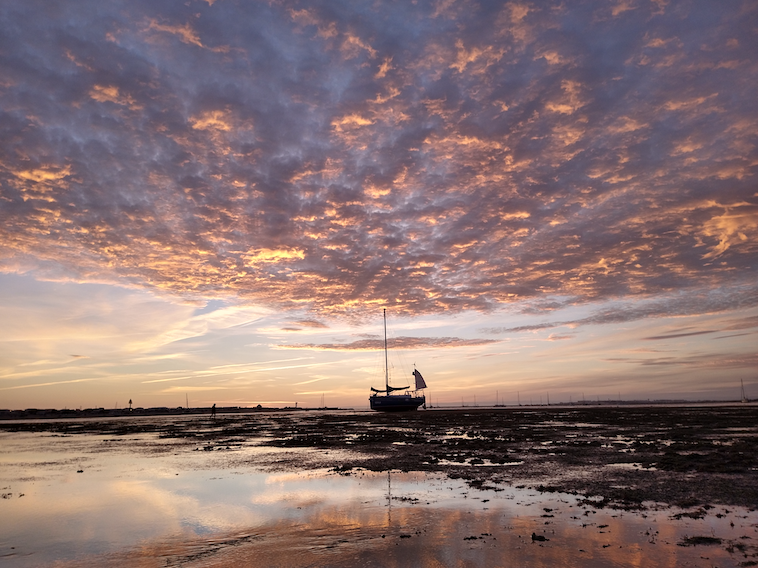
The Ya is fully insulated with 11 cm of PIR foam for a better interior atmosphere. This also gives extra floatability. Together with the air compartments and a fully closed engine room, the ship would in theory stay afloat in case of a hull damage. That is only theory. But at least it gives us time to abandon the ship in a calm and thorough way.
The rigging, the sail plan and the sailing
Before we start sailing, first the deck. The deck of the Ya is probably the only deck without ‘things’ on it. Like a genoa rail, or a stay and plating, pad eyes and what have you to break your toes. In warm weather you often walk barefoot, so the deck is designed to be completely free from ‘toe breakers’.
The yawl rig and the versatile sail plan invite sailors to sail. Its diverse possibilities are challenging for the sailors who like to use their brains, experience and feels. For this last group, the Ya could be the yacht.
The masts are carbon fibre, because it is light and spares a lot of (counter) weight. The booms are of aluminium. The bowsprit and spinnaker pole are also carbon. Now they are so light and easy to handle, that makes it worth every penny.
The smallest sail is the mizzen. It is only 5 m2, but this sail makes her even keep course in very light winds, when other yachts already have to start their engines.
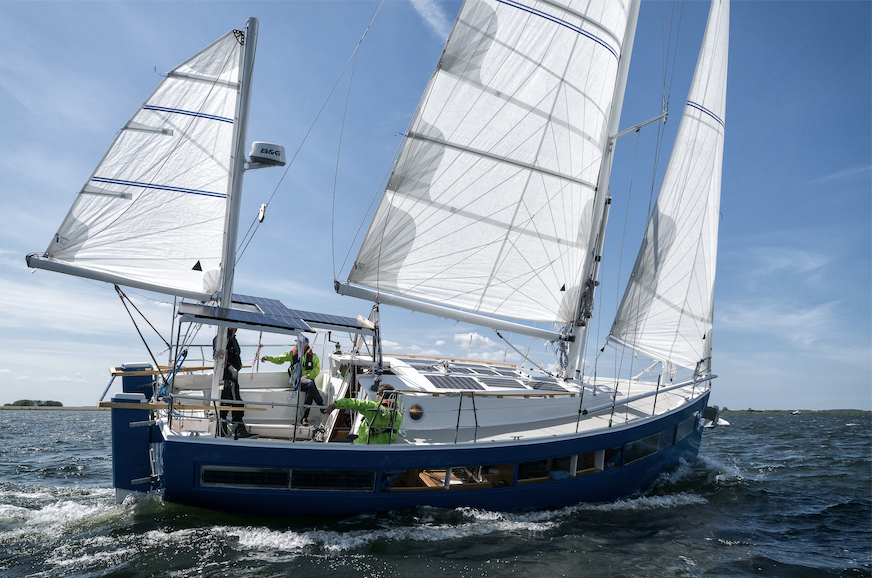
The 38 m2 mainsail is built out and fully battened for an effective propulsion. This sail works. Yes, it is opposite to the trend of mast furling. But this built out sail has the surface where the wind is: higher. And, we have no risk that the furling gear gets stuck when in a storm. The full battens also make reefing and lowering easy.
The sail has a tackline (so no fixed boom) for a better trim and to keep the shape durable. It costs a bit, but it saves a lot. So every sail on board has a tack line.
The main sail (and also the mizzen and staysail) is sea sheeted. This means with double sheets: one to starboard, one to port. This way you can trim the sail well all the way from close hauled to dead down the wind. That is not possible with a traveler rail (mostly only close-hauled trimming). The sea sheeting is worth it, because a world cruiser sails mostly running courses. The sheet blocks can be placed on several padeyes. If you put the fore sheet block to the most forward pad eye, it works as the preventer. For sailing on rivers there are two pad eyes in the toe rail, to make a quick gybe safe and easy. And, if a block of one sheet breaks, you still have the other sheet as backup.
The 20 m2 staysail is self-tacking, with a boom rotating for self trim: a big curve in the sail when running, and a sharp lift profile when the sail is pulled in. There is a tackline, to save the shape and to trim the luff effectively.
The storm staysail of 5,5 m2 can replace the staysail.
The bowsprit is 2.5 meters long, and that makes the sails effective in a wide wind angle. A course change doesnot imply that you must lower the sail and that is what I want as a lazy cruiser, just hoisted that sail.
The jib is furling around a full anti-torsi line, that also works as temporary stay. It is set on the bowsprit with a tackline that runs to the starboard cockpit winch. For the sheet we mostly use the mizzen winch.
The long spinnaker pole is exactly on length to pole out the jib. Thus, it makes the jib the most used sail in trade winds, after the staysail.
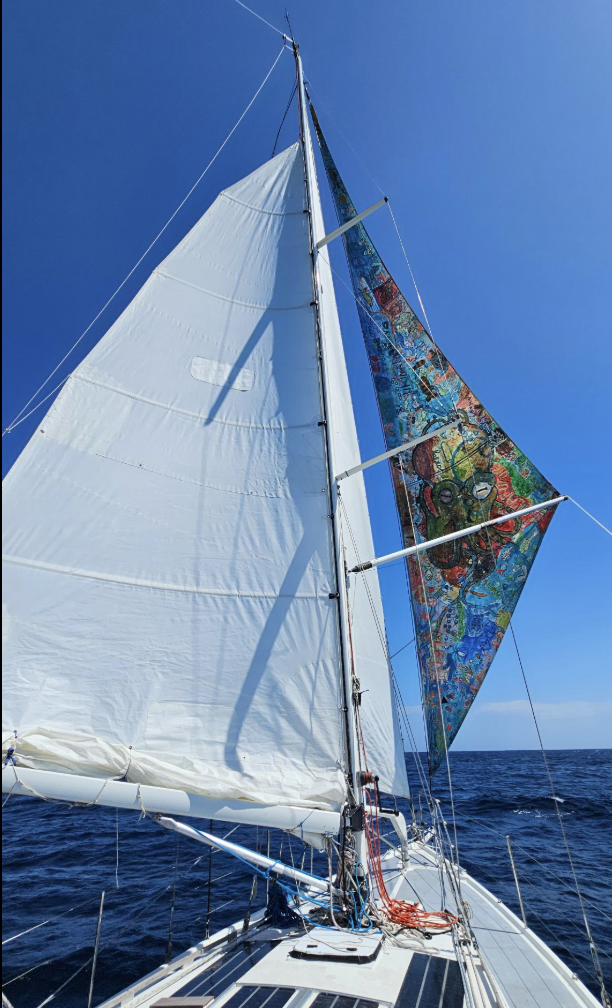
The sail is painted during a ‘Paint your Future’ project by the children of the Orphan House ‘Johanna’ in Surinam. See the film on the Fossil Free Around the World Channel on youtube.
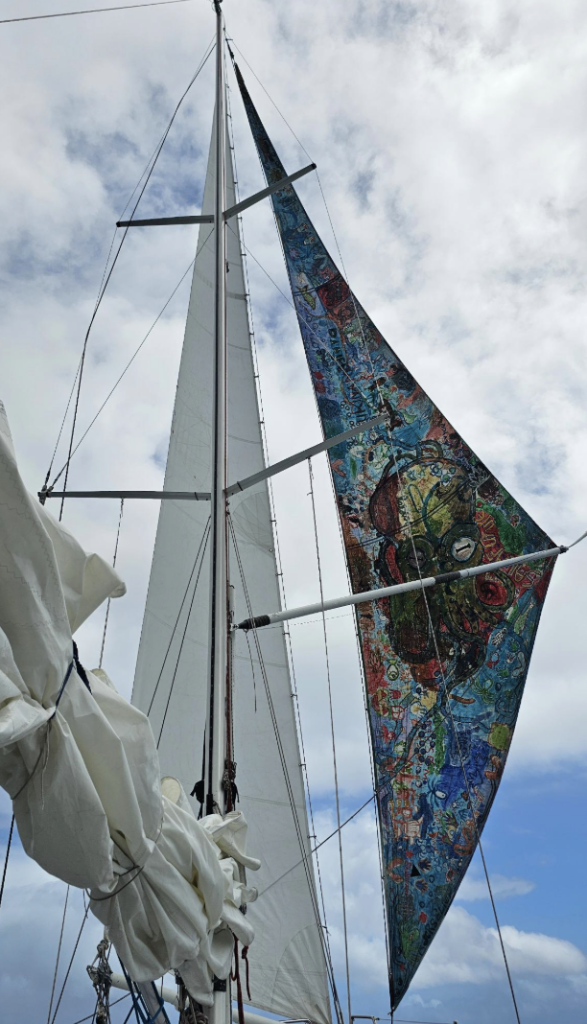
The flying sails are the gennaker and a Parasailor, both can be set on the bowsprit with a tackline (next to the jib tackline), on the stem or on the spinnaker pole.
The gennaker is made for, and works fine till 15 knots of wind. The sail does great when running or abeam. The sail can even do 65 degrees upwind, but there is not much forward power left over then. I had great joy with it, but I often kept on sailing it with an apparent wind over 15 knots and then a broach and…. 🙁 . The five tares are all repaired and sawn professionally.
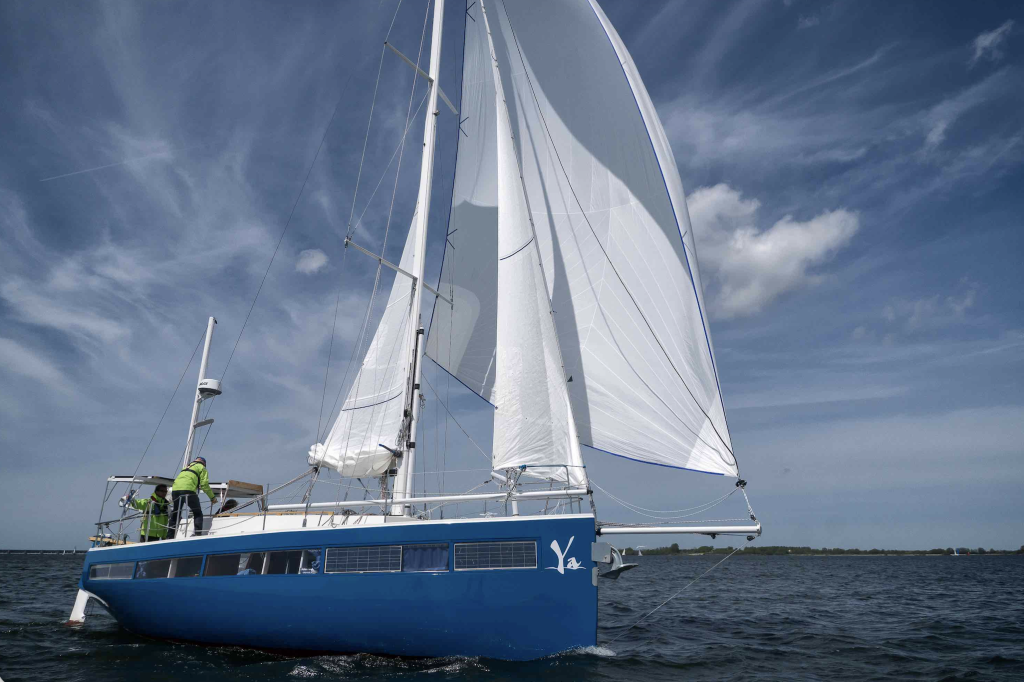
For us as a shorthanded cruisers, the Parasailor is the ideal flying sail. It sails like a steady spinnaker, and without the disadvantages of such sail. Its profile opens the sail steady in light winds of only 5 knots. When it blows 15 knots the hole in the sail works as a safety valve. You can get the sock down on your own even with 18 knots. It is a big sail, but with a bit of experience with the sock, she is still easy to manage alone. Whereas Inge always looked worried with the gennaker up, she always smiles when the Parasailor is up. We share the joy.
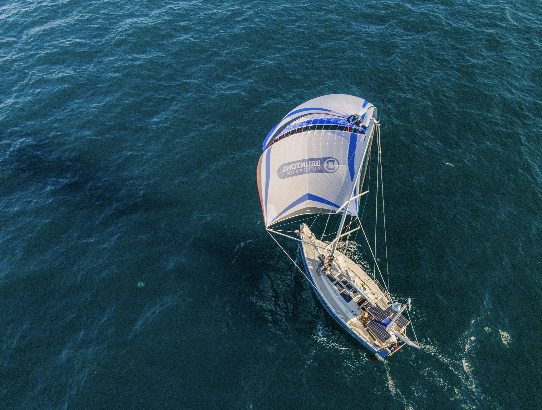
The cockpit
The two rudders are placed on a 15 degrees angle, to make the course steadier and more comfortable in gusts. It is also nice to have a backup rudder if one breaks. The Aries windvane is connected straight to the rudders, so no lines through the cockpit. The Aries steers well and steady, and if not, it is because a sail is to big or wrong sail. This really solid windvane steering gear is forgiving when mistreated, and it made my sail trim better.
Each tiller can be lifted to get more space in the cockpit. They are also used to lift the rudder blades.
In the transom on the port side a swimming ladder can be flapped out. On Starboard is a flap to make an easy step to the quai or dock when moored astern.
The cockpit is big, but green water will be drained in 1-2 seconds through two holes under the swimming ladder and flap. In the front in the corners there are two little drains for the last bits of water, or rainwater.
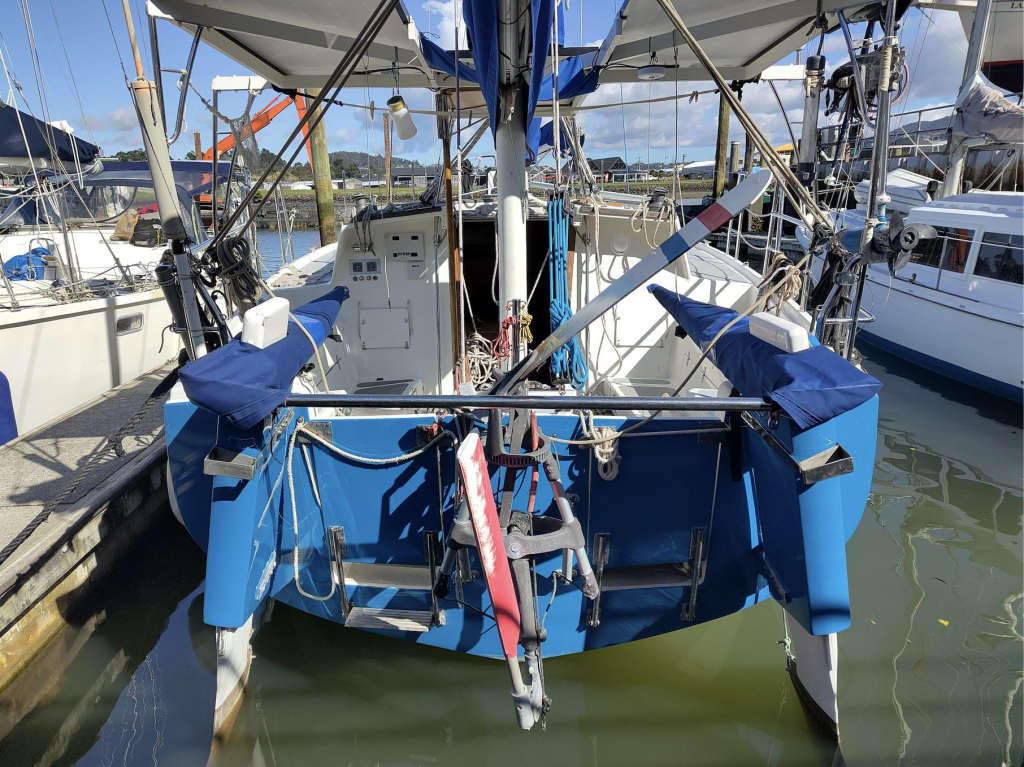
The biminitop frame is on 2 meter height from the floor (not visible here). The floor consists of a 15 cm high iroko frame. If necessary, this can be lowered 12 cm, so the height would then be 2.12m.
Behind the mizzen mast is the fender box.
The pole on the port side of the center of the cockpit functions as a steady grip. On the pole the cockpit table can be slid down.
In a rough sea I make the cockpit smaller by making lines from astern to the sides of the entrance.
There are two storages. On the port side there is the bosun’s storage, and on starboard the sails storage. Both have a wide hatch to open.
The compass is mounted on SB in the bulkhead. On the port side there is the panel and double throttle for the motors, and next to it the B&G plotter. Lower is a foldable step, in case you have bad knees. Smaller people use this step also as a seat.
There are two double speed winches, on starboard and on port over the bulkhead, just on top of the little awning. To save my lower back, I can run the winch handle on four levels: when standing on the cockpit floor, on the lower bench, on the higher bench or on the side board.
In the center of the bulkhead is a wide opening to the saloon. This width is technically possible because the sliding hatch and three wash boards are made of unbreakable polycarbonate. There is close contact to the saloon inside and the cockpit and that gives a new dimension to living and cruising on the yacht. Like on a modern catamaran.
Inside
The cockpit-saloon-contact is also close, because the saloon floor is only two steps lower.
The wide beam gives the yacht the spacious room under deck. The large full windows improve this experience and bring an extraordinary lot of daylight. When you sit you see the horizon, and what’s going on outside at sea or on your anchor spot. The height is 2.0 meter, under the sliding hatch 1.90.
The layout is traditional, so the space is not split up in cabins. Two persons can live here, and when there are guests, six persons sleep here comfortably. I chartered the first circumnavigation, with guests staying one month on the average, and we were always with two to four people.
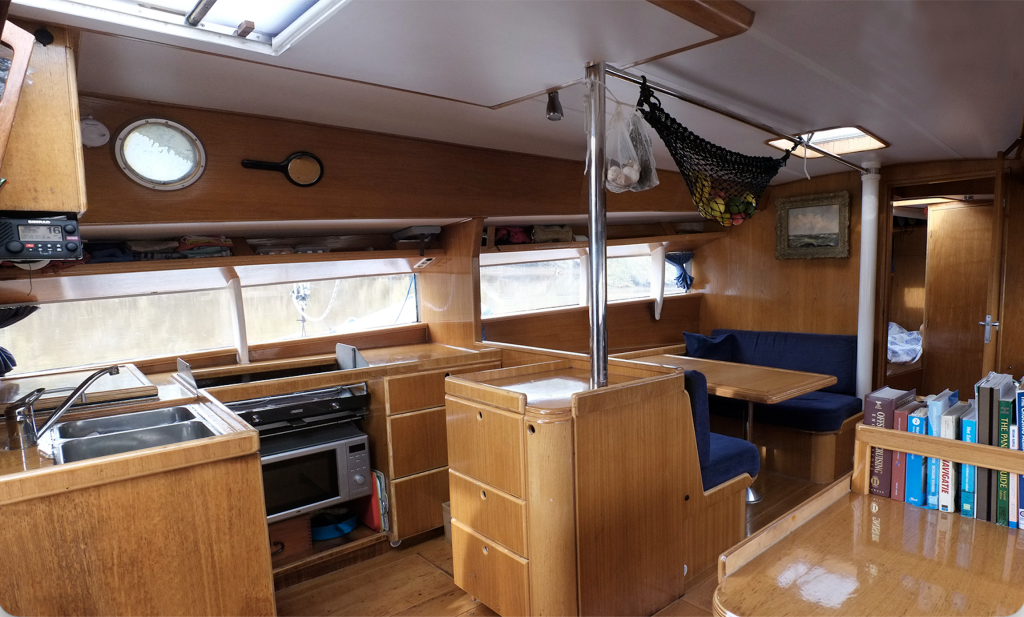
The chart table is to the starboard.
There is a book shelf on it. Next to it is a small cupboard, an outlet for 230V and two outlets for 12V/USB.
The switch board includes the 12 Volt users, anchor switch, and the device to have control on the 230Volt system. All this together works fine.
There is a navigation laptop on the chart table with OpenCPN from which we generally navigate. It includes charts for a circumnavigation, but they are dated 2011. It has GPS and AIS (reception and transmitting). The plotter outside, also with AIS, is used as a backup. There is also an iPad for new Garmin-Navionics charts, to safely enter the coasts. It has a watertight cover of thick rubber. It works also as a second back up.
The chart table also comes with a third backup, the paper charts. They cover the circumnavigation from Europe through Panama and along south Africa. There is also a sextant and the Sight Reduction Tables to get a plot if you’re able.
The drawers include a bag of flags of countries around the world and prints of most of the manuals.
One of the drawers is also built as a Cage of Faraday, to put your devices in when there is lighting.
When not under sail, we often use the chart table as desk to work on, like writing articles and so on. Privacy seems to be an attitude, because when one works there, he is not disturbed.
Before the chart table, there is the pilot berth. Behind the chart table is the quarter berth, currently used as sail storage. Both are longer than 2 meter and rather wide.
Every berth on board has its own light, a 12 Volt/USB connection and a fan.
The galley
The galley has a double sink with a washing water tap (pressurized) and a drinking water tap (foot pump). See ‘water system’ for full functioning and details.
The fridge is 50 liter and adjacent is a freezing part of 25-30 liter, just enough to freeze in a 5 kilo tuna and a 5 kilo wahoo. Usually the fridge on yachts is poorly insulated, so it consumes much energy on yachts. Then one needs a whole lot of solar panels, or batteries. Or diesel. On the Ya it is 4 times better insulated than usual and 3 times less consuming.
The compressor and element are renewed in 2026.
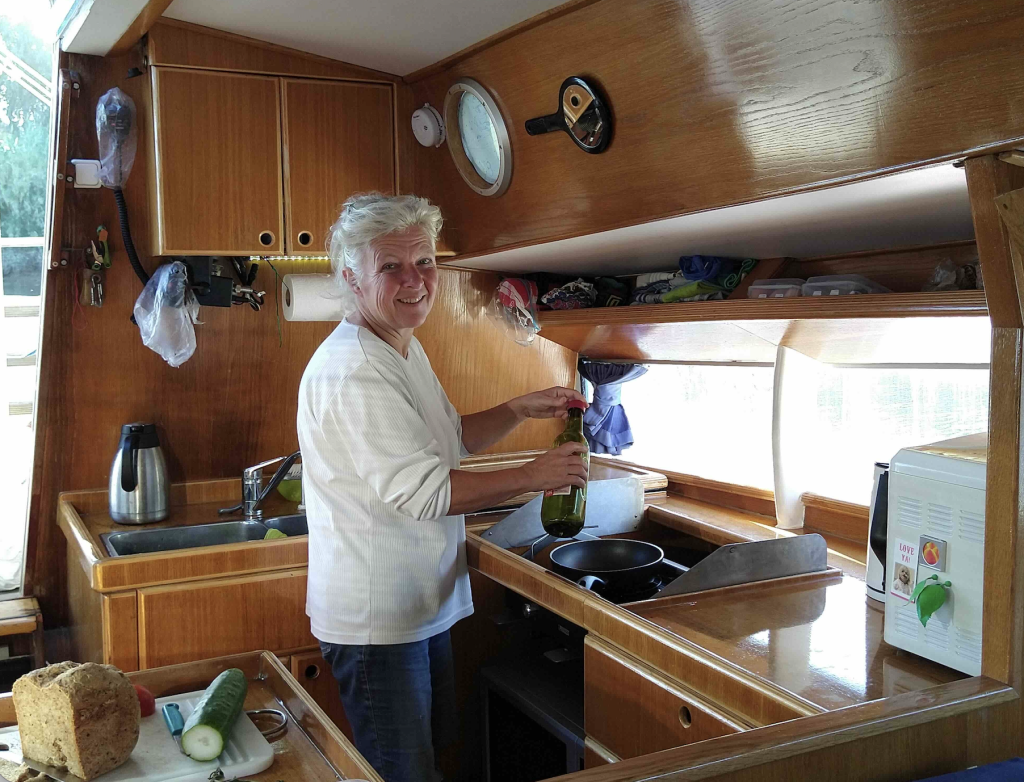
There is a double induction cooker, a double skinned water cooker, a bread baking machine, a microwave. All this saves about 70-80% of energy compared to traditional gas cooking. See the spread sheet ‘Energy Balance’ on this website, read the numerous articles about it, or check ‘Duurzaam Varen’, (‘Sustainable Sailing’ in Dutch), ISBN 9789064107801. Being free of gas, also makes the ship safer.
There is an extra cupboard with three drawers. The bottom one is an insulated ‘hay box’ to slow cook or to safely put a hot pan away. In practice it works as a third ‘burner’.
Table section
The table and couches gives plenty place for 4 persons to eat. The couches invite to lie alongside the table, what I often do. The table can be lowered and turned into a double bed. There are some cupboards on the port side next to the table and couches.
The table is just big enough to make it a six person table if necessary.
Stepping through the door of the bulkhead, you see to the right a closet for sailing coats. Afore is the door to the drytoilet, with sink and shower.
The dry toilet has its natural air ventilation through the sewer and holding tank, and into the mast (chimney effect). This way the disadvantage of a big fan/blower running continuously to suck out the smell, is effectively solved.
On the port side, there is a small double bed of 200X135/80. Before this bed there is the bulkhead to the watertight peek compartment with the anchor chain box in it. There is a watertight hatch to get into that compartment.
Engine room
The engine room is shown in the picture here under. It opens with a big watertight hatch, to keep the moist out. The blue cylinders are the motors, E-Tech 7 kW each (total 19HP). But we often call them regen(erator)s because 99% of the sailing time they are used for regeneration to feed the battery bank. Above each motor is a controller mounted. The motors are cooled by a closed cooling fluid system, including a stainless-steel heat exchange built in a recess in the skin of the hull. So, no risk on blockage or leaks by seawater.
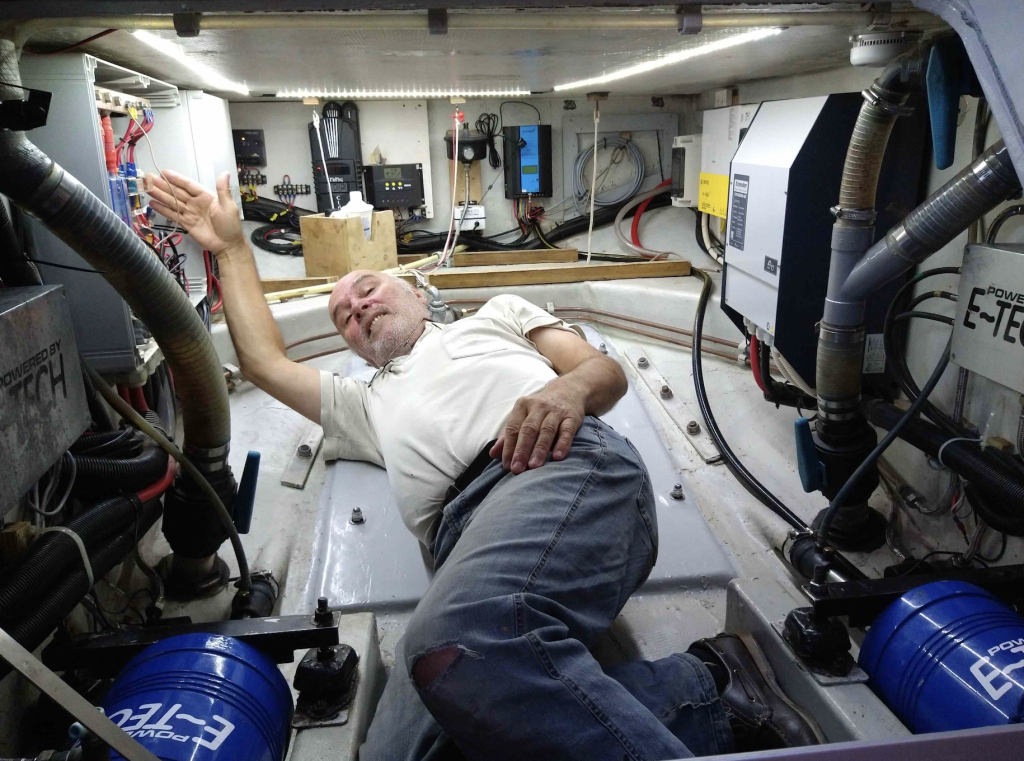
To the left side behind the motor and controller is the grey distribution box for the 48volt system. The cable from the battery bank comes in here and every connection to the various users and regenerators are made in this watertight box.
Just behind it is a little DC/DC converter, converting 48-volt to 12-volt for the board net of the yacht. Next to that is a 12-volt distribution box, for all main connections and main fuses in the 12-volt board net.
Invisible but behind this distribution box is a little 12-volt solar panel converter. The solar panels in the windows deliver their power to here and this device converts the current suitable to fill the 12-volt battery and board net.
In the aft on the bulkhead is from left to right:
- The solar MPPT converter for the bimini top panels
- The solar MPPT converter for the deck panels
- The MPPT for the wind generator, which can also be used a backup MPPT for the ones here above.
To the right side, just next to the controller of the portside motor, is the Studer Xtender inverter/converter. Its inverter takes the electricity from the 48Volt battery bank to make 230Volt for the galley equipment and more. It is also able to convert shore power to 48 volt, to charge the battery bank.
Just behind it, there is a spare converter. Just as the Studer Xtender it converts any shore power to 48-volt for the battery bank, but only up to 700 Watt.
Behind that, is the 230-Volt distribution box with fuses and connections.
Behind that is still space for a small hot water boiler. The cold and hot water lines are already installed and the fusebox has a separate fuse for it. Only, we never missed such a boiler.
Water system
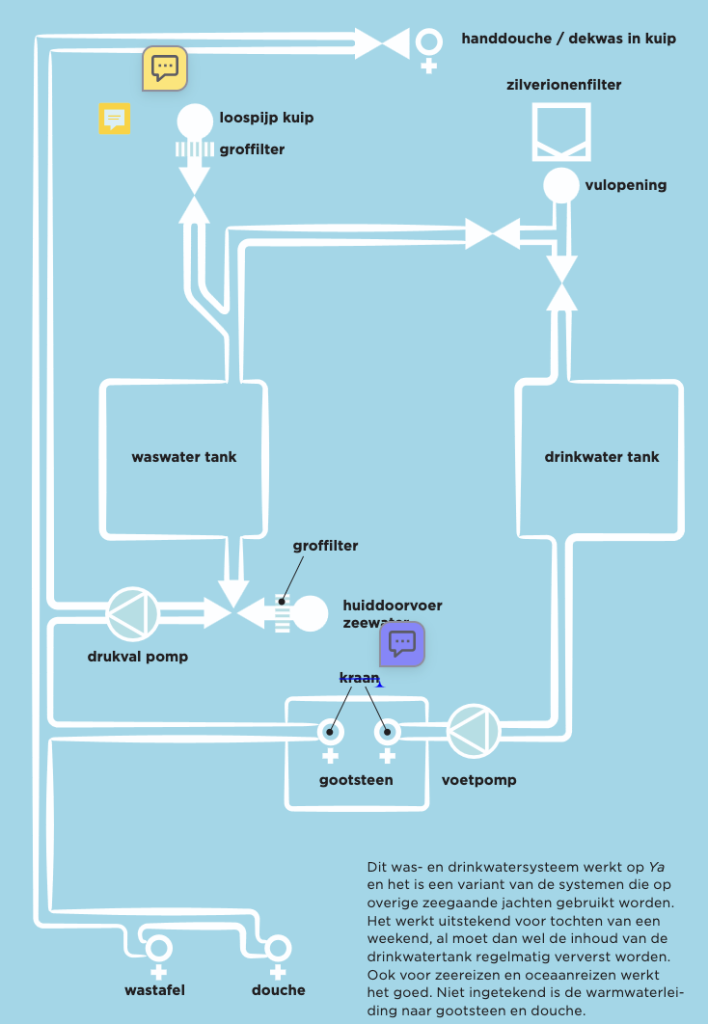
There are 2 water tanks of each 275 liter. Both tanks can be filled with a hose from shore through the hose in the boatswain’s storage.
The port side tank is called ‘drink water tank’. Only the footpump under the galley sink is connected to it. Since one has to push pump it, it saves a lot of drinking water.
The starboard tank is called ‘wash water tank’. We also used it as the extra drink water tank. An electric pump sucks the water out here and pressurizes the waterlines to the tap in the galley, to the toilet/shower tap and to the deck hose/spray rolled up in the boatswains storage.
If you like to be self-supporting, you can use the tanks and the water smarter, and catch rainwater, or use sea water if you need to rinse only. Here is how it works.
First catching the rainwater. The whole boat is designed that way that all rainwater will be drained through the two outlets in the front of the cockpit floor. When you close the seacocks (in the engine room) and open the overflow line, then the rainwater will go into the wash water tank. This is as good as fresh water, but chlorine or silver ions need to be added to prevent deterioration. Then you can get the rainwater in the drinkwater tank by opening the connecting valves, under the floor. The water will level then.
If you only need water to rinse, you can use seawater. Then, open the seacock down in the food storage bilge and push the diverter valve down. Then, the seawater is connected to the pressure pump and the wash water tank is disconnected. The pressure pump pumps the sea with pressure into the water system, which consists of the tap in the galley, the toilet/shower and the hose/spray in the boatswains storage. From there you can rinse with seawater now and save your scarce fresh water.
You read Dutch? It’s all worked out in the book ‘Duurzaam Varen’, (‘Sustainable Sailing’ in Dutch), ISBN 9789064107801.
Energy system
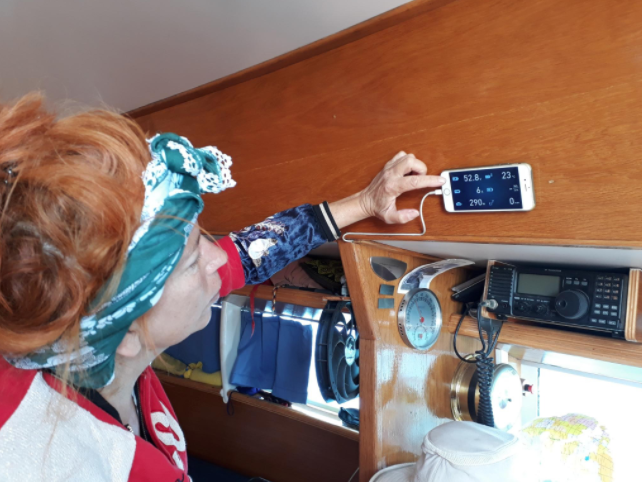
There is no diesel engine on board, just electrical. As long as you only use what you need, you can stay energy neutral or energy positive. It is a bit of an awareness that most of us lack, but you can easily get this by checking the energy meter above the chart table. That is the key thing. The technics here under is the detail stuff.
Let us follow the current of electrons to explain how it technically works. On anchor, the battery bank is charged by a set of solar panels on the biminitop, a set on the top deck, the wind turbine on the mizzen mast. That is enough to stay energy neutral.
When sailing, the solars do less because of the shades of the sails. But the wind generator does more and when over 4.5 knots, the two motors make it good. So good, that we nearly always end up with a full battery bank before we see the coast of our destination. A reliable feeling. Once only one motor worked, and we still were energy neutral. So no worries on the energy.
You can read in the Energy Balance on the website how the Ya does in various scenarios. In the book Duurzaam Varen it is worked out in detail.
Electric instead of diesel makes things more reliable, safer, and more understandable. And it is way more simple on the maintenance and repairs.
At first glance, the electricity system looks complicated, but it is not. It is way simpler than a diesel engine.
It is acrually three separate systems and these are clearly recognizable.
- The 48 Volt system. This is used to regenerate, and to store the electricity in the battery bank, to run the motors for propelling and to feed the 220Volt and 12 volt system. The 48 volt items in this system are:
- Battery bank 42.5 kWh1 biminitop panel, 720 Wp1 set deckpanels, 320 Wp1 wind turbine, 480 Wp2 motors each 7 kW, used as engines and as regeneratorsStuder Xtender to invert the 48Volt to 230 Volt AC and to charge from shore power.
- DC/DC converter Smart Solar, to feed the 12-volt system.
All connections, junctions and fuses are put in the grey 48-volt distribution box (the open box in the picture). All 48V cables to and from it, are put in a black flexible pipe.
- The 230 Volt system. This electricity comes from the Studer Xtender, or, in case you are plugged in on shore power, from shore. On the switch board at the chart table you can switch it on and off under ‘Energy’.
The 230 Volt users are:
- Galley: induction cooker, water cooker, bread baker, microwave.
- Chart table: one outlet Dinette: one outletBoatswain’s box: one outletStuder Xtender to convert 220 to 48 volt, for charging the battery bank
- (spare or if want, boiler)
In the engine room is a separate box with all connections and fuses. The 230 Volt cables are all yellow, or covered in a yellow flexible pipe.
- 12Volt boat system. This system is just like on any yacht. Except, for safety all main connections and fuses are made in the 12 volt distribution box in the engine room.
Like on most other yachts, all the lights and other users can be switched on the switchboard at the chart table.
The only maintenance the system needs is that you put the 230V plug into shorepower every two months. The Battery Management System does it from there and it is ready when you see 100% on the display.
The Studer Xtender can be set to all sorts of shore power in the world, even the irregular. And If there is no shore power available (like in the Pacific), there is a little petrol generator on board. I also use this generator as a back up.
Although a Studer product doesn’t fail, there is also a small backup charger of 700 Watt. And there is a 2000W spare inverter.
To prevent moist/maintenance on the battery bank and the BMS, the bank is installed in a watertight compartment. For an hour per day a dehumidifier and air circulation system keeps everything extremely dry there.
The little 12 Volt battery is maintained by the app of the Smart Solar MPPT. It is your choice to automatically or manually switch on the equalization process.
Survey and more
There is a comprehensive survey made in 2026 by Topside Marine Surveyors. It is done when the Ya was on the hard. Peter can send the report to you. These things came out:
- The aluminium toe rail under the GRP is corroded on some places and delaminates the GRP. Cause is water along the stanchions. I will close that, clean the aluminium and I will renew the delamination.
- The little awning over the cockpit makes a different noise under the surveyor’s hammer, so the surveyor concludes it could be delamination. Only a destructive proof can prove that. I know that the awning is built on separately in the building process and a different not constructive material is used, which makes the different sound. I understand the position of the surveyor, but I consider the chance on delamination close to zero, so I don’t take action on that. The winches and pad eyes are mounted on aluminium inserts, so no risk on that either.
- The carpentry shows various darks spots as a consequence of historic leaks. I accept that and took it into account in the sale price of the yacht. I leave the decision to the new owner to do something about it or not.
More to know:
- At Whitewhale Yachtbrokers you will find the sales text and a lot of pictures.
- On www.fossilfreearoundtheworld.org you can check The Yacht for all details and numbers. Or check the Blog for our stories the last 6 years. On History you will find older stories, including the building process.
- On the Youtube channel: Fossil Free Around the World you will see our experiences. Also with some videos sailing the Ya, like with the Parasailor.
Contact Peter on info@fossilfreearoundtheworld.org or send him a Signal app. (No Whatsapp), +316 283 44 823
List of products, devices and parts
All devices listed here, you buy with the Ya. So this is in the price included. You already read about the double motor, double solar panels, double/triple navigation system. Here under you find much more to be prepared to go safely off the beaten path.
Here and there the age of purchase is mentioned. If no age is mentioned, it is from 2015.
Ground tackle
1 Rocna anchor 25 kg, galvanized in 2026
55 meter of galvanized 10 mm Force DIN766/A chain, 2026 (it means that it can stand the heat of another galvanizing if you need to).
1 kW anchor chain winless with extra drum
60 meter of 20mm anchor line, 2020 (line fits and runs through the gipsy wheel)
50 m orange 5 mm floating line
Second anchor: 1 aluminium Fortress FX23 anchor with 25 m of line incl 10 meter leadwoven line, 2020
12 meter of galvanized 10 mm chain
200 meter roll of 14 mm polypropylene black mooring line
1 10 kg bar of lead.
Third option: 1 spudpole for ‘anchoring on the spot’ up to 2.5 meter deep
Mooring
3 polypropylene black mooring lines 14 mm 10-15 meter
2 black cylinder fenders 25cm
1 ball fender 80cm (backup, not blown up)
1 white fender cylinder 20 cm
1 fender step, works as step
Sails and running rig
- Mizzen sail 5 m2(2023), dyneema halyard and topping lift, tackline, double sheet, sail cover
- Mainsail 38 m2 (2024) dyneema halyard (2020) and topping lift, tackline, boomvang (up/down), sailcover. Ronstan battencar system (2025)
- Staysail (2024) m2 dyneema halyard (2020), tackline, sailcover.
- Storm jib 5,5 m2 instead of staysail.
- Jib 28 m2 on a furler, dyneema halyard (2020) tackline together with furling line to the cockpit winch. In sailbag.
- Gennaker 68 m2, polyprop/polyester halyard (2026), tackline to the cockpit winch. In sail bag.
- Parasailor 104 m2 (2020) with 4 sheets (2020): 2 to the cockpit winches and if wanted: 2 to the mast winches. In special bag.
- 2 Lewmar 40 double speed winch
- 2 Lewmar 14 single speed winch on main mast
- 1 Lewmar 14 single speed winch on mizzen mast
Lines, boatswain’s box
- 1 spare halyard dyneema 35 meter new
- 1 spare halyard dyneema 30 meter old
- 1 spare line for Aries
- 20 meter water hose with connections
- 5 meter flex water hose
- 20 meter yellow CE proof electricity cable 3 wire 2.5 m2 with CE plug and counterplug
- 1 adaptor CE to European
- 1 adaptor European to CE
- Boatswain’s chair
- Extra harnas with Boatswains chair
- Device to hoist yourself into the mast
- Footholder steps to put in cockpit frame
- Navigation devices
- Suunto Compass with night light
- Beamer LED 12V
- Simrad RS40A VHF (2026)
- B&G Plotter Zeus Touch (no sd card)
- B&G Extra display
- B&G Windsensor (2026)
- Airmar BST800 depth sounder, temperature, speedlog (2026)
- COBRA Float 350 Handheld VHF (2020)
- Amtrek B100 AIS transceiver (2020)
- Microsoft Laptop with OpenCPN, Predictwind, Wifi repeater, and other apps
- Sextant
- Sight reduction Tables for Air Navigation
- Wifi antenna repeater for in the mast
Motors and props
- 2 E-Tech WG7 electric motors SB 1301D5H319Z, BB 1301D5H318Z
- 2 Kelly/Etech controllers for regeneration and propulsion
- 1 telephone with the ACADuser app on it.
- 2 25 mm steel propshafts with Volvo inner bearings and outer bearings
- 2 Autoprops 415 mm
Regeneration
- (2 E-Tech motors and Autoprops, see above)
- 3 solar panels Sanyo 240Wp 24 Volt
- 1 MPPT Epever XTRA3210N/XTRA4210N for 48 V
- 4 solar panels Sinoltech Flex 03-80 80Wp (2026)
- 1 MPPT Epever XTRA3210N/XTRA4210N for 48 V
- 1 wind generator SilentWind Pro 400 (2020)
- 1 MPPT SilentWind Pro (2020)
- 2 solar panels Sinoltech Flex 03-40 40Wp (2026)
- 1 MPPT SmartSolar MPPT 100/20 (2026)
- 6 solar panels Hyett Flex Custom 10Wp
- 1 Sunware Fox 220 PWM
Battery bank
- EV-Europe 3P16S battery bank 48V Lithium Ferro phosphate, 42.5 kWh (2021)
- EMUS Battery Management System (2021)
- 1 Eva EDV-1200 Dehumidifier
- 1 Century 27lx-mf 12 Volt AGM battery (2026)
- Studer Euroconverter 48/12V (2021)
Converter/inverters
- Studer XTender 6000W-48 V Converter/inverterDC-AC Power Inverter
- HTRC p3648 smart charger 700W 48V Converter (2026)
- SmartSolar MMPT 75/15A 48/12V Converter (2024)
- EV-Europe 220V/3,2V converter
Galley devices
- Induction cooker Nova 3500W ((2020)
- Watercooker NEBIS 1000W (2024)
- Bread Baker Inventum M35
- Micro Wave ETNA ECM 153
Safety Gear
- SB and PS jackstays/-lines
- Jackstay/-line cockpit
- Liferaft Seago 4 persons, approved till April 2029
- 1 Iridium transceiver with antenna on biminitop
- 1 handheld VHF with extra separate battery set
- 2 PLB1
- 3 Secumar 275N life vests, need service, each with:
- Safety line
- PLB1
- personal laser beamers
- spare CO2 cartridge
- spare salt melting tablet
- 4 fire extinguishers, expired.
- LED Flare
- Beamer LED 12V
Dinghy
- 1 West Marine dinghy PRU-3 (2023)
- 1 set of oars
- Airpump
- Repair set
Fishing gear
- Roll with fishing line and bait
- Pieces of lead in various weights
Backup devices, spares, maintenance materials and special equipment
Sailing off the beaten path brings the extra responsibility to keep everything running. The double motor is a typical example. At sea and in the tropics, all devices are exposed to extreme sun, temperature, moisture. Technical skills on board are limited to the standard maintenance (although I learned a lot). But one doesn’t have to be an engineer to exchange things: unmounting and mounting the backup thing in.
This led to a number of extra devices, spare parts and extra equipment.
Navigation
- Spare navigation laptop, everything installed, ready to exchange
- 2nd spare navigation laptop of HP, all apps on it, it still works, but it is slow and old)
Sails, rig and ropework
- 20 various shackles
- 5 spare blocks (Rutgerson, incl mainsheet bloSpare Rutgerson block parts
- 2 spare sail battens 4 meter
- 1 spare aluminium 39mm threat nut for Lewmar winch
- miscellaneous
Sail repair set
- Sail repair tape for light cloth (gennaker et cetera)
- Sail repair strips for dacron cloth (mainsail et cetera)
- Diverse pieces of sail cloth
Rudders, steering
- Backup Simrad Tiller Steering TS10 12Volt
- Spare Aries vane
- Spare Aries tab
- Spare Aries counter weight
- Spare Dyneema lines for Aries
- Spare JEFA bearing including JEFA roll
Pumps/water
- Spare pressure pump for wash water
- Spare pressure switch for pressure pump
- Spare Ocean 12V 24-62 l/m bilge pump with level switch
- Spare Ocean 12V 24-62 l/m bilge pump with hose and plug 12V
- Maintenance set Whale foot pump drinkwater
- 1 maintenance set Trudesign diverter
Motor and props
- Grease for inner bearings
- Grease gun with grease for Autoprop
- 2 stainless steel wedges for opening propshaft coupling
- Wooden piece for under propshaft coupling
- Prop shaft bearing stops/plugs (don’t throw it away)
- 1 Spare Propshaft and key
- Spare volvo inner bearing
- 2 spare outerbearings 1” and 25mm
- 3 Autoprop bearings
- 3 Autoprop anodes
- Special spanners and adaptors for Autoprop maintenance and bearings exchange
- Autoprop small pulley
- Fixed propeller 17” 25mm (spare)
- Controller
- 2 extra cooling fluid hoses
- 1 liter of cooling fluid
- 1 spare (old but still working) double throttle
- 1 spare (old but still working) interior display for motor/controller
- Spare plastic caps buttons motor
- Spare button for motor
Electric
- 3 spare blades for SilentWindgenerator
- Set of spare/maintenance parts SilientWind generator
- Spare EMUS BMS (complete circuit board)
- Spare EV Europe battery 3.2 Volt
- Spare Studer RCC unit for xTender
- Spare inverter 48V/230V 2000 Watt
- 3 Spare DC/DC converters 39-60VDC to 11-15.5 VDC 3A
- AC: diverse plugs to get around in the world for 110/220/240/Asian/etc
DC: Diverse spare plugs and special wires (like NMEA, VHF, USB)
Paint
- Capri blue one component for touch up
- Left overs what I used during the last refit (2026):
- Epifanes Marine Primer
- White gloss paint
- Anti slip paint deck
- UV varnish
Miscellaneous
- Water bail hand pump
- Refill set for fridge (needs probably new cartridge)
- 3 12Volt fans
- Petrol generator Dehray Rig1000 (2024)
- 3 petrol cans 20 ltr
- 2 petrol cans 10 ltr
- Petrol hand pump
- Oil SAE 10W/30
- Leftover pieces iroko and oak plywood
Documents
- Certificate of Registry Netherlands
- Boat Passport (Dutch)
- CE A certificate of approval
- CIN number
- Radio license VHF and PLB’s
- Set of manuals of devices on board (paper and digitally)