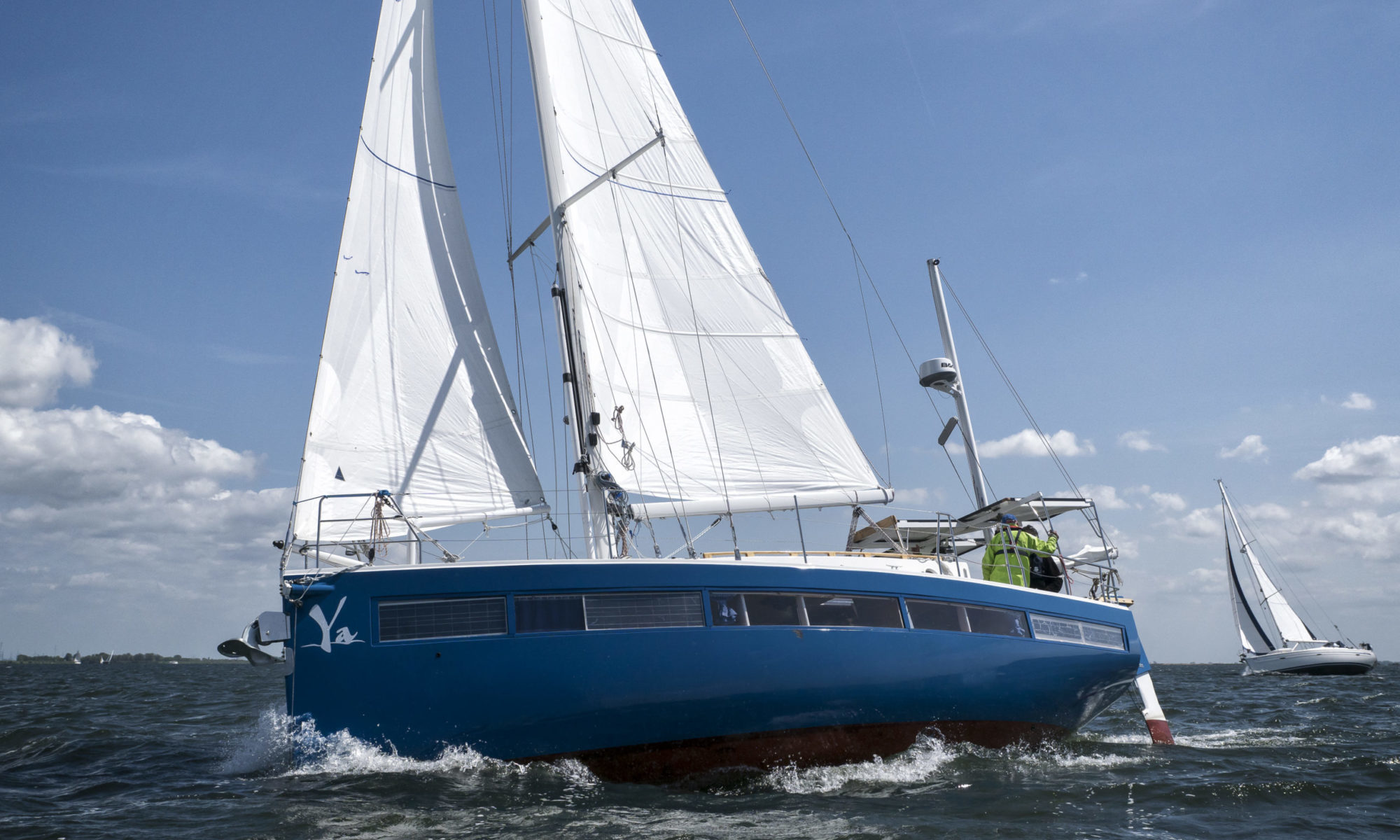
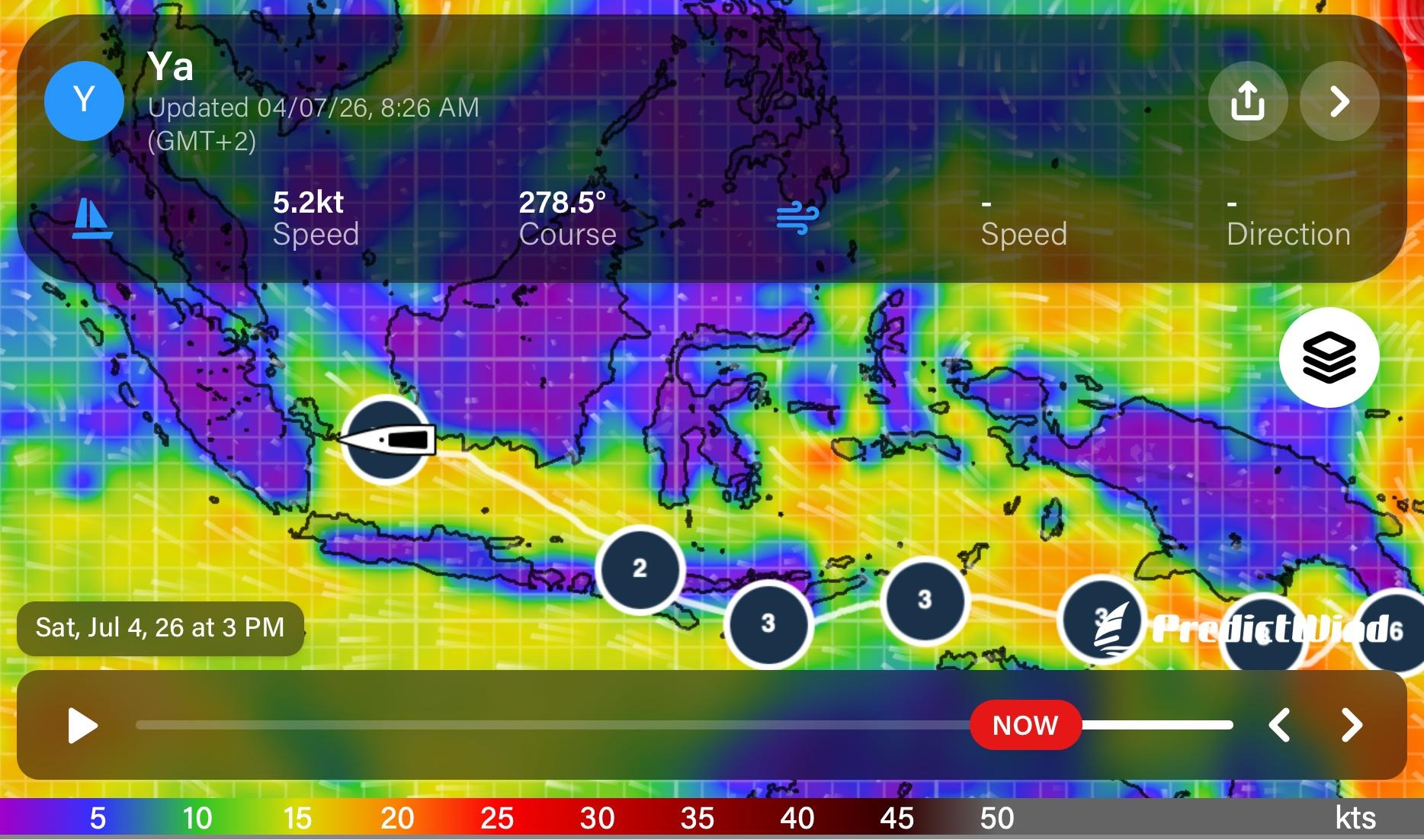
Ya is sailing from Kupang to Batam; this time there’s an extra challenge to sailing while using little energy.
weeks of light weather
27/06/26, 1:12 PM, 9 14.164S 120 12.425E
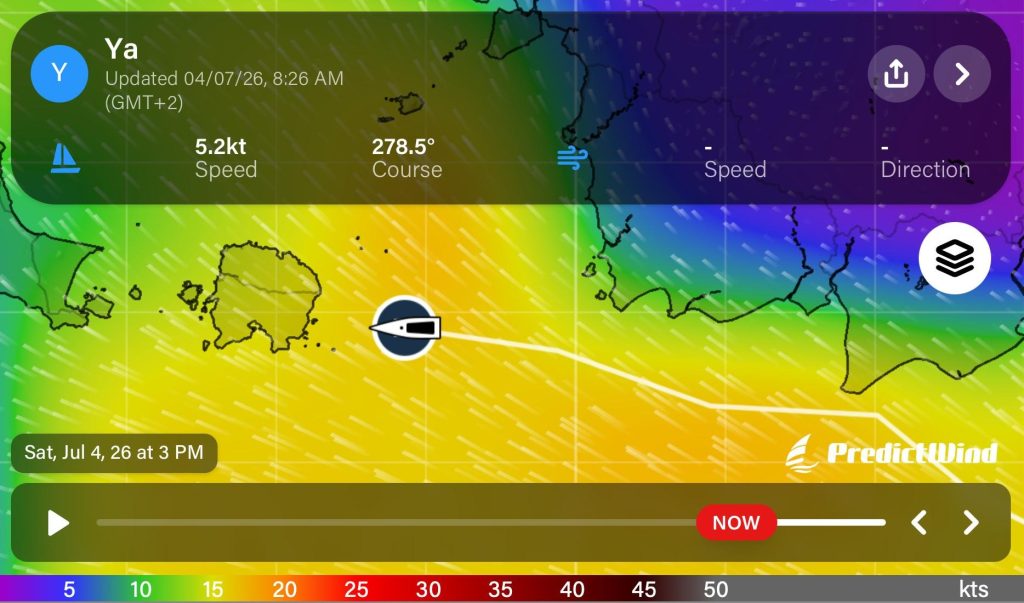
Already in the evening the Ya departed for Batam. There is a strait to cross, west to Flores island, and best is to start navigating there early in the morning. That will be the day after tomorrow. From there the journey will be another 10-12 days, or even more.
The last two months were sometimes challenging because there was lots of wind. This time it will be challenging because there are only light winds. Could be hard work with sails.
Currently we have set nearly 90 m2 (mainsail, staysail and jib) and still we do only 4 to 4,5 knots. That is on the edge of a running prop for making electricity.
The energy challenge is for tomorrow.
Backup, backup, backup
28/06/26, 12:16 PM, 8 08.102S 118 40.753E
The Ya has two motors, because one can break. The Ya has a lot of backups. I am typing into a tablet which has a backup. The satellite transmitter, called Iridium, there is an extra one. And you need it. The Iridium went broke. Software perhaps? We put the new firmware on it in New Zealand. There could be lots of things. PredictWind helps great with this. We sailed just enough along the coast to get internet and download the relevent things. So after a while the Iriidium worked again. In the meanwhile, we used the backup.
Since the port motor is defect (the controller is on its way to Poland now to be repaired), we use the SB motor, mainly to charge the batteries. But, today the propshaft went loose. So you see, only one backup is not enough – check the title.
Just sailing. A liberation
30/06/26, 11:04 AM, 5 59.441S 115 51.098E
Yesterday also the starboard motor didnot work and Peter could only fix it in a very temporary way. It is possible to use it only in forward and in slow mode.
So it is sailing and it will be sailing for the next week or more. Just sailing.
Before the seventies the motor was a ‘home bringer’. One used it to avoid the most difficult part of the sailing, to bring it into the yacht harbour. Then, we got bigger yachts and inboard engines came. The tanks became bigger. The engine became a backup in case – yes, in case for what? In case your sails rip? Actually, I don’t know. I only know not to rely on a complex diesel engine system because it won’t work in heavy weather.
Now, 50 years later, our generation has gotten so used to have a working engine, we even use it to cross complete lakes without using sails at all. Despite that, more and more ocean sailors put their tanks full, sometime 500 liters, or more, and then a bunch of canisters on the side boards. I often see 10 canisters of 30 liter on each sideboard. Would this be for safety? That is half a ton on ballast 1 meter higher then the Metacentre, where the yacht turns around when it heels over till it capsizes. I guarantee, this amount of diesel is even getting dangerous.
When yachties talk about engines, I always feel fear. Same with me. The idea of having no engine on board and do it just on sailing, fears a bit.
But the funny thing now, when you have no engine for more than one day, you get used to it. You rely on the wind, the boat and yourself. Now you really understand people who sail without an engine. Now, having no engine, gives a fear less.
It feels like a liberation.
Energy balance
04/07/26, 3:41 AM, 3 15.392S 109 52.816E
Since the motor doesn’t generate electricity, there are only the solar panels (we sail with the wind in the back, so the windgenerator delivers close to nothing). How does it work? Will the Ya make her destination before the batteries are dead?
If you check the Energy Balance on the website, we use about 2,5 kW per day. That is 5% of the battery capacity. With the battery bank on 70% now, we could sail another 14 days. So no worries But still the solar is working.
To be always on the safe side, the consumption is reduced.
* The plotter and auxiliary screen (using 30 Watt) in the cockpit is off now, and the navigation is done by the the little laptop (20 Watt) which is always on. This saves 30W X 24 hours = 720 WattHour (Wh)
* the 230 Volt is switched off and only on for cooking. The inverter and laptop adapters are taking 20 Watt when running idle (so when the laptop batteries are full) so that saves about 22 hours X 20 Watt is 440 Wh
* just being more critical on lights, saves an estimated 4 hours X 10 Watt, so that is 50 Wh
All together, the energy is brought back with 720+440+50 WattHour is 1330 Wh. That makes a reduction of 50% of the regular consumption.
The sun shines great from 10:30 to 13:30. Then the mainsail covers the solar panels, and after a gybe there is another hour of full sun on the panels. That delivers on the average hour about 400 Watt. So there is 1200 Wh coming into the battery bank. These are LFP batteries, so there is hardly any loss on charging or uncharging.
So actually, the household is in balance. With a loss of 1330-1200 Wh the deficit is 130 Wh. The Ya can continue sailing half the world this way!
This is another example how easy it is to start first at the consumption side before even thinking of regeneration. Because it is 3 times simpler, cheaper and safer and quicker.
ps: lots of sun is good for energy on board of Ya, but not so much for human skin.
For those readers who want to protect their skin from the sun, but do not wish to harm the marine environment: read again