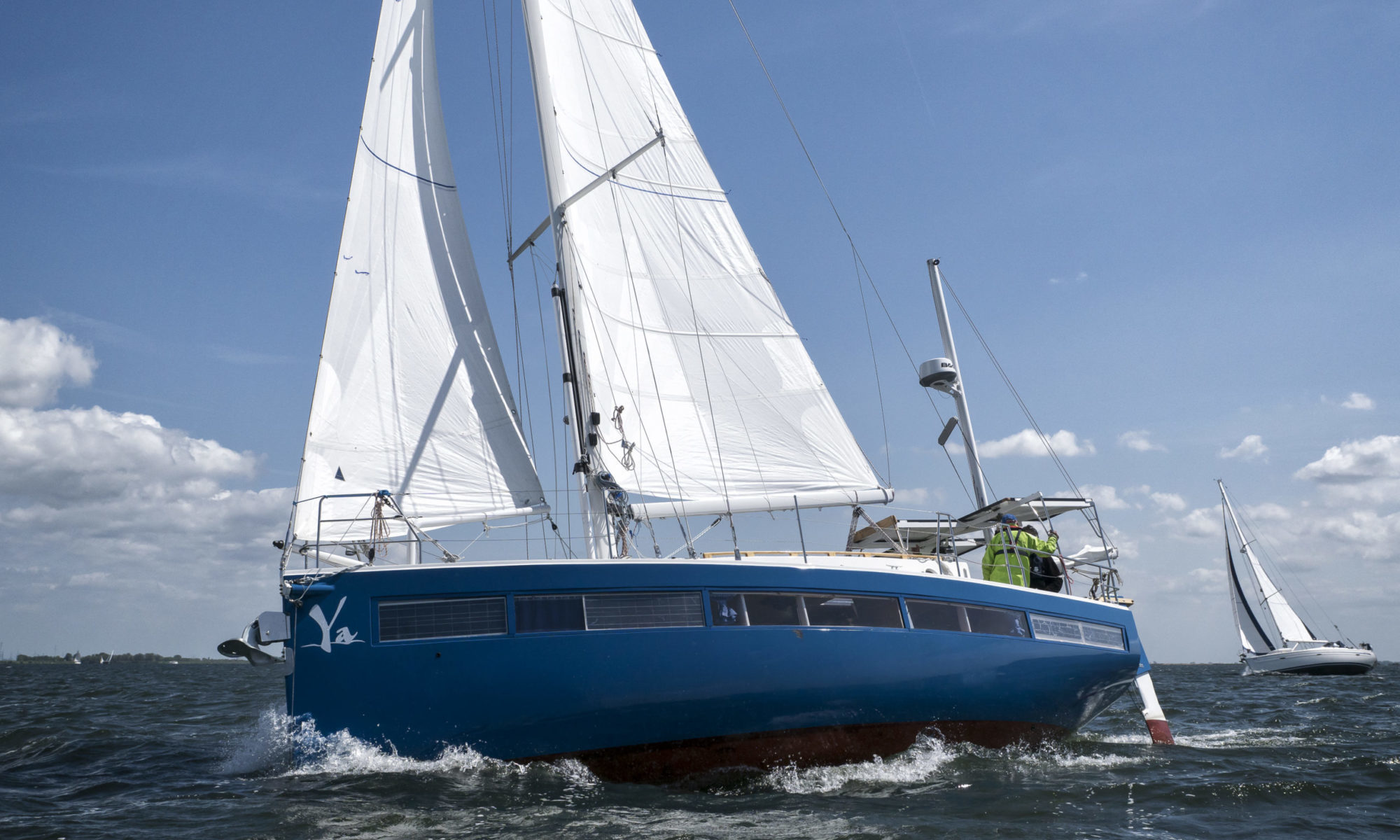

All things considered, the root cause appears to be a smoke detector that worked too well. Or, on a more operational level, the most likely culprit was a small inflation pump, combined with—even aboard the sustainable Ya—a nearly empty petrol jerrycan and possibly the lithium-ion battery from the navigation laptop igniting it. But I will analyze that in detail in the second part of this two-part series.
In this first part, Peter details the actions taken both before and during the fire. After an introductory section, he follows the timeline strictly, starting from the afternoon prior to the fire.
Preliminaries: prevention and suppression
I’ve always found it odd that insurance companies mandate fire extinguishers but not smoke detectors. Then again, that’s likely down to the ‘prevention mindset’ I developed after thirty years of working in environmental management—which is essentially just another form of safety management. Personally, I’m rarely impressed by so-called firefighting ‘heroes’ anymore. I’m far more impressed by the unassuming person who implements a few smart measures to make the problem disappear entirely. I mean the people who prevent energy consumption in the first place, rather than the individuals and organizations constantly battling the energy crisis with vast arrays of solar panels, wind farms, and other costly money pits.
Moving from environmental management back to safety management on the boat: I buy the required fire extinguishers because the insurance company insists on it. Back in 2015, it took a bit of searching, but fortunately, I managed to find Prymos extinguishers for the sustainable yacht Ya; they met all the requirements while being relatively eco-friendly. They were highly innovative, operating simply via a standard aerosol-style button. To obtain CE certification, inspector Tom van den Heuvel had to generate quite a bit of paperwork for the commission in Brussels because the units were 200 ml too small. No problem; we simply bought two of them. We jumped through the hoops required for CE certification and insurance compliance.
Now, on to actual safety measure, the prevention. For the price of the cheapest little fire extinguisher, you can buy the finest, most expensive smoke detector imaginable. It comes with a 10-year warranty. This is what we love. I bought one for the engine room and one for the galley, and I replaced them in 2020 before our second circumnavigation.
The high-quality detectors I had, did have one drawback: they turned out to be *too* sensitive at times. In the tropics, around five in the morning, the relative humidity on board often rises high enough to trigger the galley detector, causing it to beep and wake us up. I used to take it out of its mount and move it to a different spot each evening until the beeping stopped. That spot ended up being next to the forward cabin, where I sleep. That worked fine, too. Or so I thought.
July 11, 16:30
Galang Baru, Indonesia. The Ya has been on anchor for a few days near the sustainable, reusable house Perry is currently building. We enjoyed a long, delicious late lunch at the restaurant next door. I paddle back in the kayak, climb aboard the Ya, secure the kayak, and know exactly what I’m going to do next.
Inge will be joining the crew in a few days, so I want to service the small petrol generator before then. Yes, ever since our Pacific crossing, the Ya needed a generator to maintain the LFP batteries. They require balancing every two months—something that we can’t achieve with solar panels alone. Normally, I’d just pull into a marina and plug into shore power, but there are hardly any marinas in the Pacific—and certainly not in the areas where the Ya is happiest. So, while in Gambier, I had to buy a small 700-watt petrol generator.
I haul the thing—about the size of a sewing machine—out of the bilge. I flip the navigation laptop on the chart table back out of the way, leaving plenty of room for the generator. I lay down a cloth underneath and get to work unscrewing things. I drain the last of the petrol from the system into a jerrycan (no, not a cup). I screw the caps tight on both the jerrycan and the tank. I clean the air filter and check the spark plug—nice blue spark. A jet in the carburettor looks a bit clogged, so I add some carburettor cleaner. Then I hook up the air pump. It’s a 12-volt pump—about 100 watts (8 amps)—that we normally use for the kayak. It has two internal pumps: one for volume, and a piston pump that kicks in to build up high pressure once the initial inflation is done. There’s a sticker warning not to run it under load for more than 15 minutes. That’s not an issue, though, since the whole kayak inflates in five minutes. And for the carburettor, I only need it for a minute or two.
18:00
Then Inge calls from the Netherlands. It’s around noon there, but since it’s the weekend and we’ve got plenty of time, we have a nice, long chat.
19:00
It is dark. I can’t properly check if the carburetor is truly clean right now, so I decide to reassemble it tomorrow. The generator doesn’t actually smell, since everything has been taken apart, cleaned, and aired out, so I leave it where it is.
Normally, I’d haul the kayak onto the topdeck in the evening while it’s still nice and firm. It loses a tiny bit of air, so doing this now is easier than topping it up with the handy little air pump tomorrow morning. For now, I just leave the kayak where it lies. I’m going to get something to eat.
20:30
I drag my mattress out of the forepeak and lay it on the foredeck. I pull the sheet-bag over it and climb in. Usually, I sleep naked in the tropics, but tonight I slip in wearing my underwear. A light breeze is blowing from the southeast, and a gentle flood tide is coming in from the south.
Sitting with a cushion against the mast, I handle a few emails and watch a bit of a movie on my laptop, using my mobile phone as a hotspot. Then I go to sleep.
As far as I know, I was sleeping soundly and wasn’t woken by anything. Perry later pointed out that, on my first night sleeping on deck, I had been woken by a violent roll—violent enough to make my laptop slide off the bed and end up against the toe rail. Apparently, if another boat passes by (which rarely happens) and your vessel is positioned parallel to its bow wave, it can cause quite a violent roll.
During the night, the tide turned and the ebb current picked up. As a result, the boat gradually shifted to lie more and more beam-on to the wind.
03:00
I wake up to a smell. A really nasty, foul odor—just a brief whiff, then fresh air again. I look and see wisps of smoke drifting out of the companionway and across the deck. I jump up and run along the windward side deck toward the cockpit. I peer down the companionway. In the moonlight, the smoke looks grayish-white near the top, but dark lower down. It’s smoke. No fire, no flames. Likely a fire just getting started. I recall from my week-long firefighting course during military service that glowing substances don’t ignite gasoline. The instructor would open a jar of gasoline and dip his cigarette into it; it would hiss and go out. Ignition requires a higher temperature—from a flame or a spark.
It is obvious that the smoke is coming from the starboard side. I immediately step down into the cabin (the Ya’s companionway steps are only two rungs deep). My leg feels hot, but it’s bearable. I slide the fire extinguisher out of its bracket; the plastic cap pops right off. Good. This extinguisher is designed like a simple spray can, and I already have the tip of my index finger on the nozzle. At least, that’s what I can deduce later from the location of the burns on my fingers: the index finger was less affected. But I don’t know for sure, because suddenly, a massive red-orange fireball erupts from the darkness below me, rushing past my legs and shooting upward just as I leap away. I remember that part vividly. After that, I think instinct took over. How long it lasted or what exactly I did—I really don’t know. Did I run back and forth along the side deck? Or did I snap back to reality the moment I reached the foredeck? Inge later read back the notes she had made during our first phone call. I recall I wanted to seal off the entire cabin entrance to smother the fire, but did I actually do it? I have no idea. I also told her the door between the forepeak and the cabin was closed, yet I felt it was too dangerous to approach the fire through the forepeak. Later, I also seemed to recall flipping up the mattress to open the forward hatch. But it remains unclear whether I actually did that or merely considered it as an option. In any case, human memory isn’t reliable in situations like this—mine included—even though I usually have a pretty clear head at such moments.
Anyway, I find myself standing on the foredeck. I try to figure out what to do. I only manage this by shouting at myself: “No, don’t jump right away—think first!”—things like that. I notice the kayak is missing from the deck, then remember it’s still in the water on the leeward side. I need to get to it. That’s better than jumping overboard, because I’m a poor swimmer. I shout instructions to myself until they sound coherent. The final version:
“Take a deep breath and hold it! Run as low as you can along the leeward side deck to get into that kayak!”
It works; four or five seconds later, I’m standing in the kayak. I’m crouched low to stay beneath the smoke, gasping wildly for air.
Then I realized I needed to call for help. Once again, I worked through the plan by shouting instructions out loud until the whole thing sounded feasible. Standing in the rather soft kayak, I pulled myself along the foot rail toward the bow, then—with a dexterity born of experience—maneuvered around the anchor chain. On the starboard side, level with the bow, I groped for my mobile phone. Groped, because the foot rail is above head height there. I grabbed my laptop, which was resting against the foot rail. I kept groping, repeating to myself: “Grab the laptop, but get the phone first!” And I found it. With the laptop and phone in one hand, and the other pulling my standing body toward the hull, I now had to get down. Normally, you can’t manage that without a line to lower yourself—hand over hand—while using your feet to press the kayak against the hull. But I didn’t have a line. I had a mobile phone and a laptop in my hand. So I took a gamble and let myself drop very quickly. I landed with one knee in the kayak’s rear seat, one knee just on the side of it, and the hand holding the laptop and phone in the front seat. The kayak hadn’t shot out from under me, nor had it capsized. I believe the impact of the fall caused the rather soft kayak to buckle slightly, letting in a surge of water.
The kayak drifted a few meters away from the boat, carried by the current. I felt a sense of time and space. That brought a calm I needed to take control of the new situation. I dropped the laptop onto the seat cushion and placed the phone on top of it to keep it dry. I grabbed the paddles and began paddling furiously, channeling the last of my fear-fueled energy. I eyed a spot that might be faster to reach but was unfamiliar, yet opted for the small jetty by the restaurant where I had docked earlier. Halfway there, I paused to call my friend Perry, but my fingers were too wet. I kept wiping them dry on my body and trying again, until the smell of smoke hit my nose: I was right next to the Ya again, now only about 15 meters away. That’s when I paddled like a madman toward the jetty. I started shouting for help as I approached—”Boat on fire, help!”—but all I got in return was Indonesian grumbling from the various sleeping quarters, the tone making it clear I should shut up. I persisted. Out of sheer habit, I hauled the kayak onto the jetty; only then did I feel the burns and see a blister on my upper arm almost as big as the arm itself. So, into the water I went. Treading water, I held onto the edge of the jetty with my left hand.
In the water, I barely felt the burns. I kept shouting. Yes, someone was coming. I shouted again: “Fire on ship, help!” and “Call Perry, telephone Perry.” Others appeared too, but they only used their mobile phones to shine a light in my face. I pointed at the ship, but perhaps they couldn’t see the smoke or didn’t understand my English.
But suddenly, it all became clear to them. They jumped onto the local passenger boat and headed for the ship. I gathered from their gestures that they were extinguishing the fire there. But the boat they were using to fight the fire returned far too quickly—dousing the remaining embers requires close attention and takes much longer than simply putting out the main blaze. The boat docked at the jetty where I was clinging on, and where a few people were now standing. Three proud men stepped out, and one of them said to me: “No worries, fire out.” I realized the danger to the ship of not properly extinguishing the fire, but saw the impossibility of explaining that to them. And now there was a greater danger: my health.
I asked him for an ambulance: “Telephone ambulance?” Five minutes later, I received a sort of affirmative response. Perry later told me that they had indeed called, but the ambulance simply doesn’t come; this is an impoverished area, and they only drive out if they are certain of payment. (Yes, Indonesia is beautiful, but society is harsh). I kept asking the bystanders to call Perry.
03:50
It didn’t take long for the light of an initial flame to become visible again. By now, I was asking: “Please take a picture, take a photo!” Someone did, and I asked them to call Perry. It turned out to be one of Perry’s employees. He had called—Perry told me later—but Perry had slept through it. However, the employee then sent Perry the photo that he had been taken and called again; immediately alarmed by the photo, Perry called him back. It was five minutes to four, as Perry’s call log later revealed. I got to speak to him, too; I was incredibly nervous and already starting to feel the cold.
“Perry, come quick—there’s a fire on the boat, it’s terrible, fire on the boat, come fast. Bring burn ointment if you have any!”
“Peter, I’ll be there in an hour.”
I stayed by the jetty, treading water. Half an hour later, someone had the idea of handing me a lifebuoy. It turned out to be necessary. I struggled to get into it, simply because of the cold and exhaustion. I was shivering and my teeth were chattering. I remembered from maritime college that these could be signs of impending shock. So, I started memorizing exactly what I needed to tell Perry when he arrived: “Get some bottles of water from the restaurant and have them ready in your car. Pull me out of the water by my hand and armpit. Tell your mate on the other side to do the same. Keep going until I say STOP; then I’ll handle the rest myself. Then help me into your car.”
I kept repeating those instructions as my body shifted increasingly into ‘energy-saving mode.’ I stopped moving my legs unless the burning sensation made them hurt. The chattering and trembling in my jaw and shoulders, however, grew worse.
04:55
Perry arrived. I blurted out my instructions. Perry understood the situation. They pulled me out of the water; I was wearing only my underpants. Even in the dim light, my legs and right arm looked bad. They helped me to the car. A woman quickly handed Perry a bunch of aloe vera stalks. He sliced the first one open with a pocketknife—”This has to be better than water”—and handed the knife and stalks to me.
We drove on. I was shaking and my teeth were chattering violently, yet I managed to keep slicing open new stalks and smearing the gel onto my legs or arm. I could hear what Perry was saying quite clearly; I was lucid from time to time. I even managed to point out an unlit moped to him—they are a common sight there, often riding on either side of the road. Fortunately, Perry was driving calmly.
Despite my constant anxiety, the burning sensation in my legs, torso, and arms intensified. Nevertheless, Perry drove to the most distant hospital—which, as it turned out, was the only right choice.
06:00
The emergency department was efficiently organized. Seeing Perry’s fine new car, they assumed he had money and asked for an upfront payment. Within three minutes, I was lying on a bed with gauze covering my torso, legs, and right arm, while three nurses sprayed the dressings with sterile saline solution. About 30% of my skin was burned, mostly with second-degree burns.
I was prepped for surgery.
7:30
The surgery was scheduled to start at 7:30, but first Perry had to sign about 30 documents for approval: “Sorry, sir, but these are our Standard Operating Procedures.” By then, I was no longer able to read anything, let alone sign it; my right hand was also burned, and the pain was unbearable. There was still no sign of anesthesia—the signatures had to come first.
08:00
While I was being put under general anesthesia, Perry received a call from the head of the island’s regional police. They wanted to be absolutely certain that no crime was involved. Naturally, they also asked for all the boat’s paperwork, visas, passports, and so on. These had likely all burned up. However, Peter had provided the number of the agent in Kupang who had handled the customs clearance, thinking he might still have copies. When Perry called him, the response was rather vague; the agent couldn’t recall Ya or Peter. It later turned out that the agent had been suspicious: a “local” asking to have all those copies sent over just like that?! Instead, the agent sent an email to Inge asking her to verify the authenticity of the message. At that point, Inge knew absolutely nothing; Peter had asked Perry that she not be called until after his surgery so he could tell her everything himself.
10:00
A worried Inge called Perry, who clarified the situation.
By this time, several other agencies had contacted Perry requesting a statement: the provincial police, the immigration police, the harbormaster (transport and waterways authority), the navy, and the water police. Fortunately, the hospital and Perry managed to prevent them from questioning Peter directly.
11:00
I woke up from ‘total anesthesia’. I looked like a mummy.
I heard afterwards that it had taken an hour to clean the wounds. Another hour later the legs, the right arm, and a third of the torso were completely ‘packed’.
12:00
The hospital had made a separate consultation room available where Perry could speak to the authorities one by one. The problem remained the missing papers. Had Ya and Peter entered Indonesia legally? The authorities wondered out loud.
Fortunately, Perry had received all the documents from the agent through Inge. After the police had established the authenticity, things became calm. At the end of the afternoon the last person left the hospital consultation room.
4:00 PM
Fentanyl is a great painkiller and it was used during surgery. But that was worked out in the afternoon and the regular painkillers took over. I felt the pain that was only getting bigger, and would get even bigger.
At that moment I decided to do one thing: first get all the energy into my body to heal. My body is the vessel of my mind and my mind will be able to process it all better.
Now, almost three weeks later and having just started rehabilitation therapy, writing down this experience is the first step in this process.

Amal Bros Hospital, Batam, 27/7/26. Thanks to Perry Parengkuan for his tremendous support.