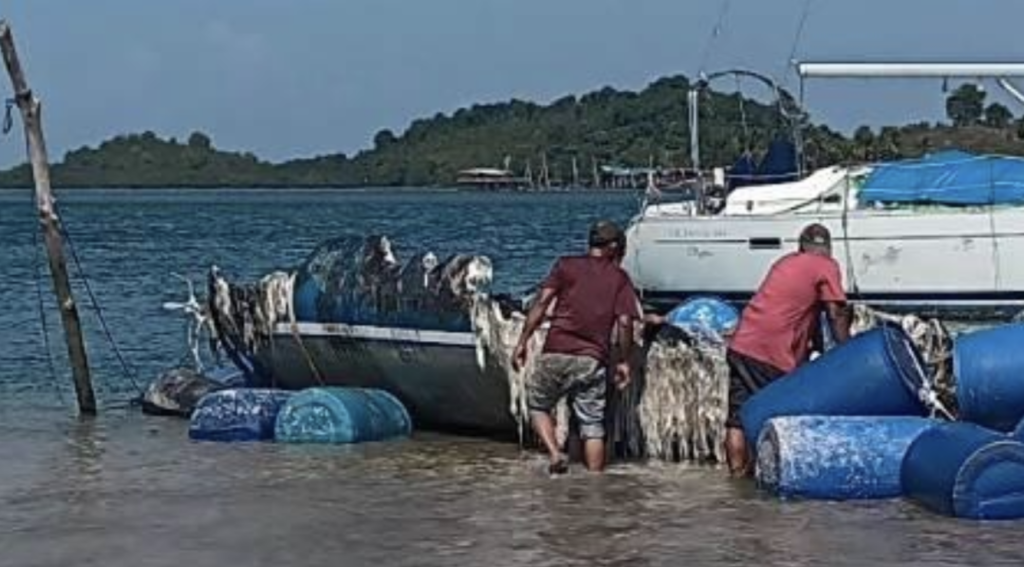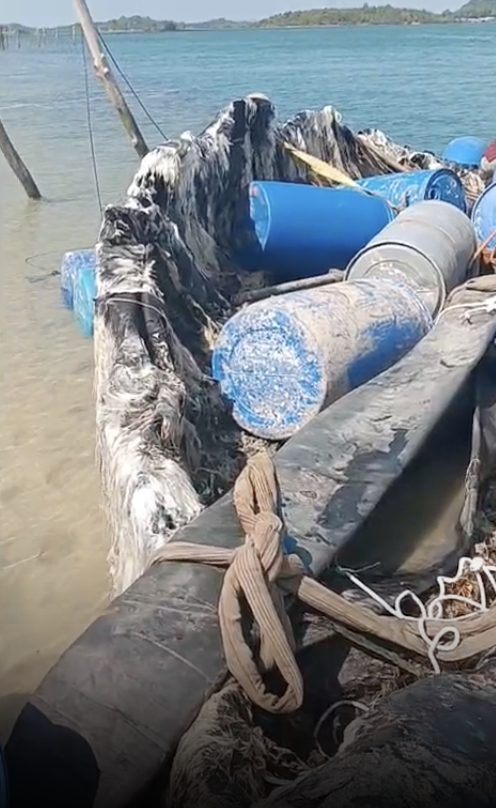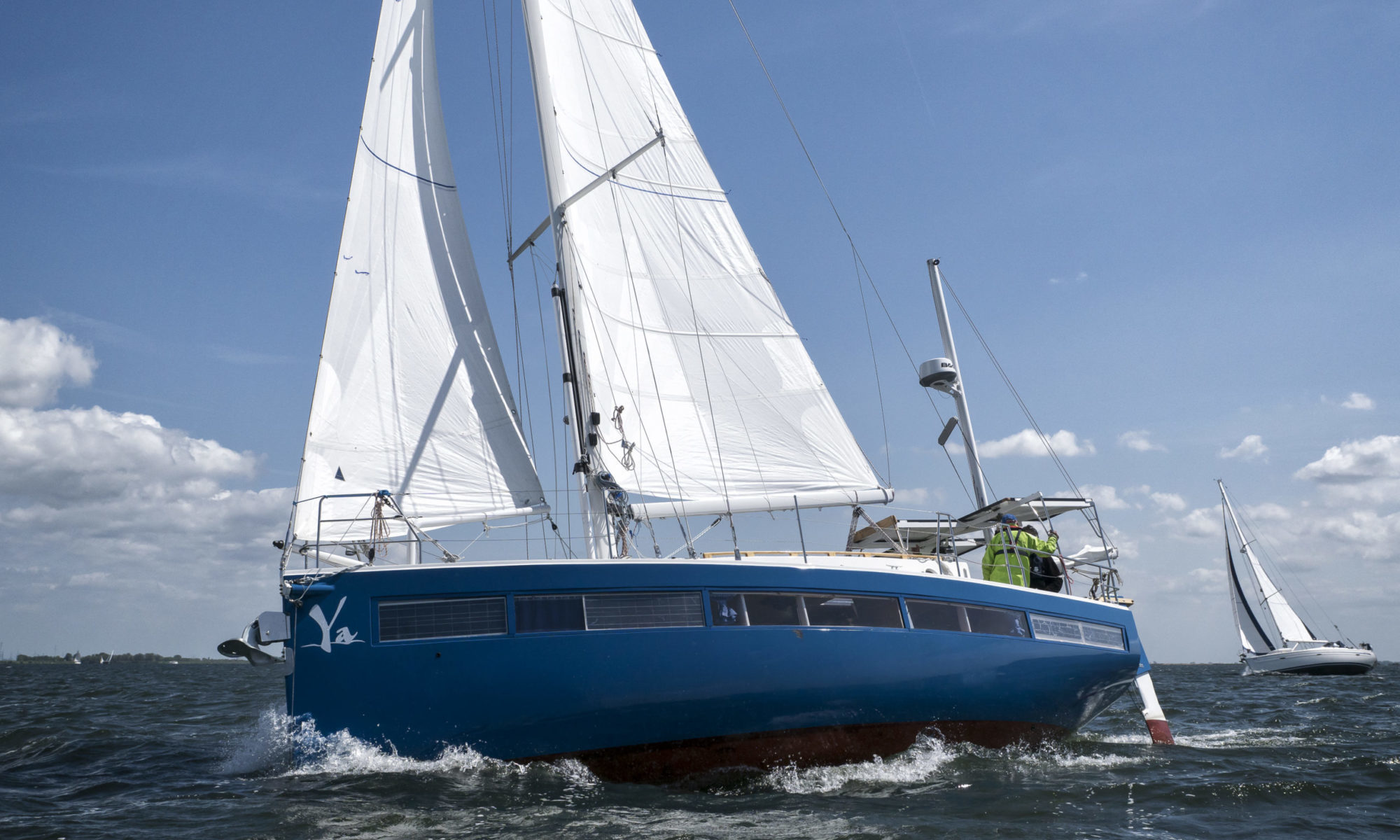
In the first part, I described the situations and all the details that could have caused the fire. So, what is the most likely cause? Usually, one looks for the immediate cause at an operational level. Let’s start there.
The smoke inside was coming from the starboard side. It must have been the cushion one sits on behind the chart table. That makes perfect sense, as the material produces a great deal of smoke while burning. It is not self-retarding, and the seat connects to a full-sized mattress for the quarter-berth, so there is plenty of fuel for a fire.
How could it have been ignited? The only thing I can think of is that the air pump switched on. It must have tipped over by the waves of a passing ship, and the ‘On’ button was accidentally pressed. I wouldn’t wake up to that sound while out on the foredeck. There is a warning sticker stating it shouldn’t run for more than 15 minutes—yet that is exactly what it does. The small electric motor would heat up and melt the polyethylene casing. Even if the polyethylene—which is highly flammable—didn’t ignite from the heat alone, it would only take a tiny spark from one of the electronic components to ignite the gas being released.
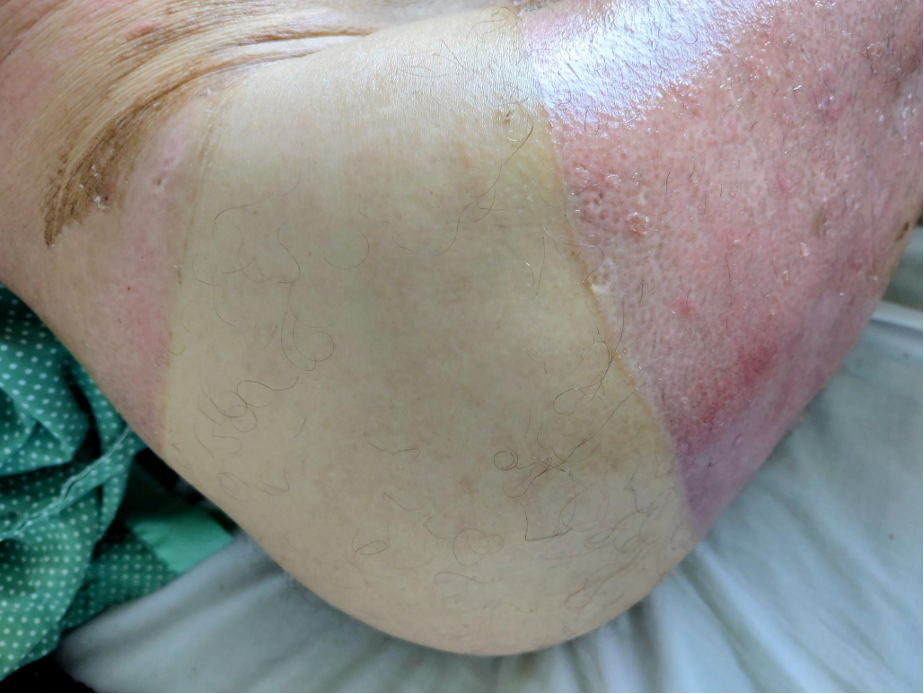
Now, regarding the flame—the fireball—that hit me. The fire smoldered through the cushion material and must have heated the nearby jerrycan containing the small amount of drained gasoline. The heat caused the contents to expand. The plastic grew hot and pliable until a hole melted through, allowing the excess pressure to escape with a hiss: the gasoline vapor forced its way through the smoke. The gasoline ‘cloud’ spreads and ignites into a ‘fire cloud’, around my legs and (the back of) my arm and body.
Gasoline only ignites at a higher temperature than the glowing temperature of the cushions. What caused the gasoline vapor to ignite?
It may be possible from a still active air pump, but that chance seems small to me. Nearby, on the chart table, is also the navigation laptop there and it has a Lithium-Ion battery. Such a Lithium-Ion battery is of course still a scary thing, but it seems to be especially dangerous at higher loads. I closed it and then it is in sleep mode. At night I turned off the 230 volts, so it was not charged. It is possible that it short-circuited due to the heat, or that the lithium-ion battery itself became too hot and ignited. That’s enough to ignite the gasoline vapor. My second phone may have been there too, also with a lithium-ion battery.
A completely different possibility is a short circuit in the wiring behind the switch panel, which runs tightly along the starboard side across the full width of the chart table—or a short in the wiring beneath it. As it happens, the wiring was replaced during the refit in New Zealand. A professional did the work, and when I inspected it at the time, I saw that everything had been zip-tied just as neatly as it was originally. I think the likelihood of a fault there is slim. Furthermore, the smoke generation is hard to explain in this context; a fire would have to be well underway before flames could reach a cushion. The flames would have reached the jerrycan long before that.
Often, after this kind of “firefighter’s analysis,” the full range of other potential causes is overlooked. However, in the environmental and safety management within the industries I worked for, a root cause analysis is conducted for every (potential) accident, revealing a much wider array of contributing factors. Many decisions—often at the management level, sometimes at the design stage—can either contribute to the problem or eliminate the causes entirely. For instance, instead of that small generator, I could have bought a fuel cell requiring zero maintenance. Admittedly, it would have cost five times as much, but in hindsight, it would have been far cheaper. Alternatively, I could have simply sailed across the Pacific for three years, accepting the accelerated aging of the battery bank.
You can view the smoke detector I bought six years ago in the same light. It was overly sensitive—triggering an alarm during periods of extremely high relative humidity, often in the early morning in the tropics—so I kept moving it further away from the galley until it ended up in the forepeak, where it remained silent. Had it been set to a lower sensitivity, it would have stayed in the galley and almost certainly gone off sooner. I would still have suffered fire damage, but I could have extinguished the fire in time. I could also have opted for even more fire-resistant cushion material. While it doesn’t burn like polyethylene, there are covers and treatments available that provide fire retardation for several minutes. It is possible that the heat from the burning air pump wouldn’t have ignited the mattresses, and the incident might have ended without serious consequences. On the other hand, there were tarps nearby, and those burn too.
So much for prevention. In terms of fire suppression, I could have installed a sprinkler system to spray the entire interior of the vessel. I did consider this during the design phase. Aside from the high cost, the limited fresh-water capacity meant it would have to run on saltwater. That often leads to seized valves, so it wasn’t a viable option. A large CO2 (or inert gas) extinguisher to flood the space was another idea I considered. That works well in an engine room because it is an enclosed space. But for a cabin where the entrance is almost always open? Forget it. I had four extinguishers on board instead of the two required in this case—so that didn’t help. In any event, suppression measures generally perform poorly compared to prevention strategies—much like in environmental protection or healthcare.
Conclusion about the cause
From a ‘technical’ fire brigade perspective, the most likely cause is the following chain reaction:
1. Switching on the air pump, which continues to run for so long that it becomes too hot.
2. What causes the pillow to ignite and glow.
3. The glowing mass heats the empty petrol tank, the wall softens, after which a stream of petrol vapor is released.
4. The laptop’s lithium-ion battery becomes too hot and catches fire, or heat from the glowing mass is locally hot enough to ignite the gasoline vapor
5. The flame cloud eliminates me as the only fighter.
A more solid cause is a smoke detector that does not work (or works too well). If it had been hanging in its original place, I would most likely have been on site much sooner and could have extinguished the small fire. With an extinguisher, or perhaps with a well-aimed bottle of water.
The fortune and misfortune; between life and death
We cruisers go to the most beautiful countries and bays and enjoy it. Now I experienced the downside. The people are hospitable, even sweet, but the society is harsh. To my horror, I could have been dead a few times in this case. Here is an insight based on the timeline, about the moments of good luck and bad luck.
8:30 PM
If I hadn’t slept outside, I would have smelled the smoke sooner. 3 seconds earlier would have been enough. On the other hand, if I had slept inside and only woken up by the smoke detector, I might still have been late because I would have had to climb out through the hatch.
03:00
I wake up from the smoke because the current has put the Ya abeam to the wind. If the tide had been different, it would have been later. A little later, after the flash fire, I could have extinguished the fire. Much later? Then it would have been a raging fire and it would have been difficult for me to disembark.
It was fortunate that the kayak was still in the water, ready to sail. It prevented me from jumping straight into the water. Swimming perpendicular to the current, I might have ended up on a shore with sharp coral and a mangrove forest, so without people. That’s hopeless, I probably wouldn’t have made it.
It was lucky, as it turns out, that I happened to grab my laptop. Bureaucrats usually create as many barriers as possible for the vulnerable and that’s you. For example, the Accident Insurance asks you to log in with your bank details in your personal environment – oh so easy – mijnachmea.nl. Well, my passport, digital pass, telephone with SIM card, insurance papers, everything went up in flames. But with that laptop and what’s on it, Inge was able to overcome some barriers. This way we were able to email the insurance company that logging in to the ‘personal environment’ will be impossible in the coming weeks because the necessary items have gone up in flames.
A piece of vital luck is that I fell straight down in the kayak and managed to avoid landing next to it. It must partly be due to my experience, but I had some luck with that. We have of course practiced climbing back after capsizing till it was a piece of cake. But how would it work with the burns on both legs? Laptop and telephone would of course have been lost.
It’s bad luck that almost no Indonesian can speak a few words of English. Not even: “Fire on ship!” They took action much later.
Bad luck for the ship is that they have no idea how to put out a (then) fire. After putting it out, one needs to keep watch and extinguish every little flame coming up. But there was no after care at all; when the fire was out, they left immediately. So fifteen minutes later it flared up again.
The fact is that Indonesia is simply a tough country. So you’re out of luck if your boat burns down there and you end up with burns. No matter how hard you call an ambulance, they won’t come to the more remote areas. You’ll just die.
Life-saving is the combination of the following:
- • My constant shouting to call Perry. After 45 minutes I was contacted by a Perry employee.
- • My question if he wanted to take a photo. Fortunately, he spontaneously texted it to Perry.
- • Luckily, Perry woke up at 4 a.m. after the second call and looked at his phone. He then saw the picture of the burning Ya and was immediately awake.
- The greatest fortune is that there was (and is) someone like Perry, who speaks Indonesian, understands the culture, the society, has a car, knows to drive quietly for mopeds without lights on the unlit road. More concretely, the following:
06:00
Fortunately, Perry knows in advance that the ambulance will never come (which turned out to be true).
Fortunately, there is a hospital an hour’s drive away that can deal with burns.
Luckily, Perry knows this too.
7:30
Fortunately, Perry pulled out his credit card and immediately advanced a few thousand euros.
Fortunately, Perry signed the 30 forms (almost all of which concerned shifting the hospital’s liability to him or me) without hesitation.
9:00
Fortunately, I chose earlier in Kupang with the last crew (Geerhard) not to do the customs clearance myself, but through an agent. So all the papers were with him. This, plus Perry’s continued consistent story in the interrogations, took the Ya and its skipper from the realm of criminal suspicion to a ‘normal’ accident.
11:00
The police wanted to interrogate me. In Indonesia it is advisable to bow to the authorities. Fortunately, the hospital nevertheless had the courage to refuse to interview me. After consultation with Perry, the hospital offered a consultation room where – again such luck – Perry took many hours to undergo all the interviews with the authorities.
Knowledge, practice, will
I was not aware that the gasoline from the almost empty tank could ignite. I had learned that the temperature of smouldering substances would be too low to ignite petrol and so on. I knew wrong.
Besides good and bad luck, there are things you can know in advance. My presence of mind contributed to my salvation. This is not created by ‘talent’, but simply by practice and knowledge. Always practicing the fire role and the Abandoned Ship role with every new crew on board. You then know that only presence of mind can save you. This made me start shouting the instructions to myself loudly, thus forcing me to think clear and accurate.
Having practiced with the kayak is another example that contributed to my saving.
The knowledge that you have to cool burns, that you have to lie in the water, and stay there, against the unreasonable. This knowledge and practice proved later to help me stay away from mortal danger.
The local SIM card in your phone can be of vital importance and I had it.
Flipside of the society
In my experience, the ordinary people in the countries we visit are incredibly kind – think of the dear woman, still unknown to me, who cut fresh Aloe Vera for me. It seems: the poorer the nicer. But as cruisers we must be aware that those countries are often harsh. The bureaucrats are ruthless, and your vulnerability can get you into big trouble, and no bureaucrat cares if you die. Examples are the ambulance service that is not allowed to come and get you, and the hospital’s ‘Standard Operations Procedures’. The bureaucratic power applies equally to the police. A well-known saying in Indonesia is: “Do you have a problem? Don’t go to the police, because then you have two.”
Perry once helped someone who had an accident on the street. A healthcare provider came by. He was willing to help if Perry paid. “I don’t even know him yet, why should I?” To which the caregiver said: “It is easy. When I squeeze him, blood comes out and when I squeeze you, money comes out.”
So don’t count on healthcare without a credit card; they just let you die.
Help from friends in such a society is invaluable. Without Perry, without his adequate actions, without his will to take responsibility at every turn, I probably wouldn’t have made it.